

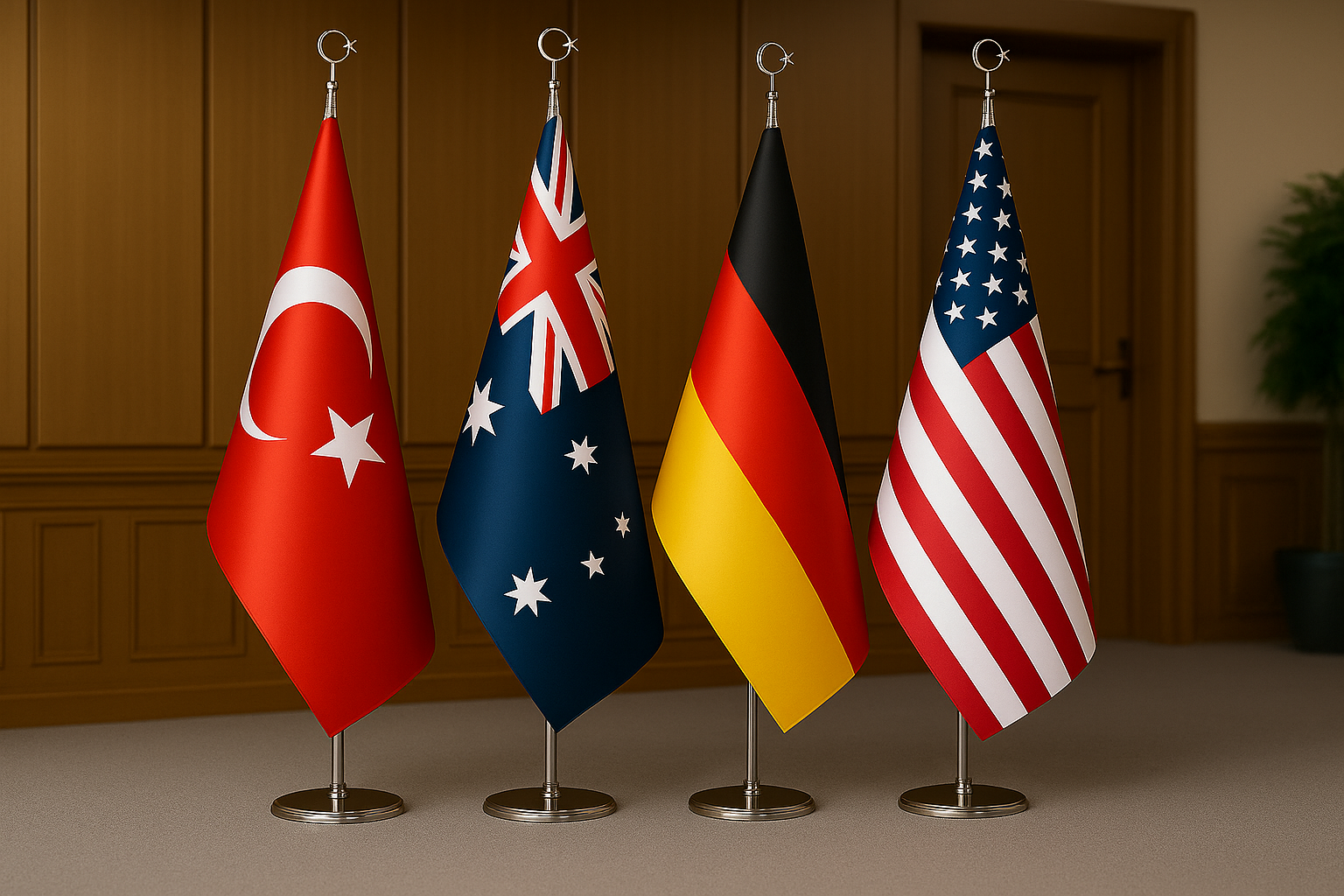


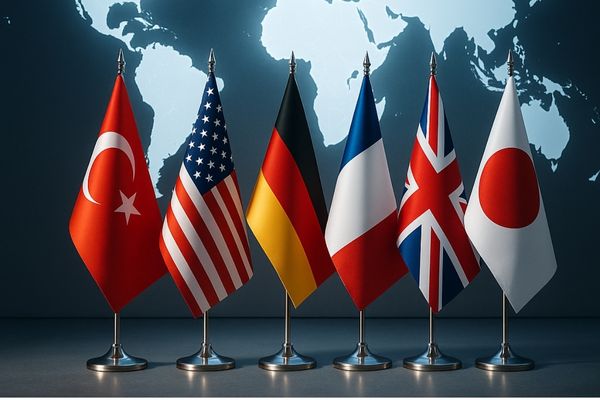



The flags of Asia represent some of the most symbolically rich and visually distinctive national banners in the world, spanning designs from Japan's minimalist crimson disc to India's spinning chakra and the star-and-crescent motifs of South and Southeast Asia. Across 48 sovereign nations, asian country flags draw on deep wells of religious tradition, imperial history, and natural symbolism — making them a fascinating study in how identity is compressed into color and form. Whether you are a student of vexillology, a government procurement officer, or simply curious about the world, this guide walks through the major visual and symbolic themes that unite and distinguish the flags of this vast continent. For display-quality reproductions built to outdoor standards, browse the full Asian Countries Flags collection from Asya Bayrak.
The Role of Color in Asian Country Flags
Color in the flags of Asia is almost never decorative — each hue carries a codified cultural or political meaning rooted in centuries of philosophy, religion, and statecraft. Red, for example, appears on flags from Japan to China to Vietnam and carries connotations of energy, courage, and in many socialist states, revolutionary struggle. Green dominates the flags of Muslim-majority nations across South and Southeast Asia — Pakistan, Bangladesh, Saudi Arabia, and the Maldives among them — because green is the traditional color of Islam, associated with paradise and the Prophet Muhammad. White signals purity or peace on flags from Afghanistan to South Korea, while saffron orange connects Indian and Southeast Asian flags to Buddhist and Hindu traditions. Blue, though less common across the continent, anchors the flags of nations with strong maritime identities such as the Philippines, and it features in Israel's Star of David bands. Understanding this color grammar makes it possible to read the broad religious and political geography of the continent simply by looking at a row of asian country flags side by side.
Religious and Philosophical Symbols on Flags of Asia
No other continent embeds religious iconography into national flags as consistently as Asia does, reflecting the continent's role as the birthplace of virtually every major world religion. The star and crescent — universally recognized as an Islamic symbol — appears on the flags of Turkey, Pakistan, Malaysia, Uzbekistan, Azerbaijan, and Turkmenistan, among others, though its precise origins are pre-Islamic and connected to the Byzantine and Ottoman empires. The Dharma Chakra, the 24-spoked wheel of cosmic law from Buddhist and Hindu tradition, occupies the center of India's tricolor and is rendered in navy blue on a white field — one of the most immediately recognized national symbols in the world. China's five-pointed stars on a red field encode Maoist political philosophy: the large star represents the Communist Party and the four smaller stars the four social classes united under its leadership. Israel's Star of David (Magen David) on a white field between two blue stripes is one of the most ancient and widely understood Jewish symbols in human history, while Cambodia's iconic Angkor Wat temple — the only national flag in the world featuring a building — references both Buddhist heritage and the height of the Khmer Empire. Sri Lanka's Lion Flag carries a Sinhala lion holding a sword, symbolizing the bravery of the nation and its Buddhist majority; the sword itself points to the four corners of the flag, representing the four cardinal virtues of Buddhist practice.
 Japan's national flag — the Nisshōki, or "sun-mark flag," commonly called the Hinomaru — is one of the most recognized flags of Asia and arguably the most elegant in its simplicity: a single red disc centered on a pure white field, representing the rising sun. The design's proportions are formally specified in Japanese law as a 2:3 ratio with the disc diameter equal to three-fifths of the flag's width, placing it at precisely the optical center. The sun has been the supreme symbol of Japan since imperial mythology identified the Emperor as a direct descendant of Amaterasu, the sun goddess — giving the Hinomaru a divine as well as national resonance that stretches back more than 1,000 years. For outdoor display, the Japan Outdoor Flag from Asya Bayrak is woven from heavyweight nylon with UV-resistant ink, rated for 80% UV protection and a typical outdoor lifespan of 6 months to 2 years depending on climate conditions. The flag is finished with a canvas header and brass grommets built to meet the standards expected of diplomatic and institutional displays.
Geometric Complexity and FIAV Standards
Several flags of Asia rank among the most geometrically complex national flags on Earth, and reproducing them accurately requires strict adherence to the construction specifications documented by the Fédération Internationale des Associations Vexillologiques (FIAV). Nepal is the only national flag in the world that is not rectangular — it is a double-pennant shape, a crimson field with blue borders housing a white moon and sun, and its construction is defined entirely by geometric angles specified in Nepal's Constitution of 1962. Bhutan's flag is divided diagonally from lower-left to upper-right with a white dragon (Druk) crossing the boundary, requiring the dragon to be rendered at precisely the correct scale and orientation — a printing challenge that separates quality manufacturers from low-grade suppliers. Sri Lanka's flag has an intricate border of orange and green stripes flanking the lion panel, each with defined proportional widths. Kyrgyzstan's flag features a stylized tunduk — the circular crown of a traditional yurt — rendered as a 40-ray sun pattern that must be geometrically exact to be legally correct. At Asya Bayrak, every Asian national flag is produced from verified official construction sheets, ensuring that the geometry is accurate whether a flag measures 3 ft × 5 ft (91 cm × 152 cm) or 5 ft × 8 ft (152 cm × 244 cm).
East Asian Flags: Minimalism and Imperial Tradition
East Asian national flags tend toward controlled, deliberate simplicity, often rooted in imperial or dynastic visual traditions that predate modern nation-states. Japan's Hinomaru, discussed above, is the archetype of this aesthetic — a single powerful symbol that needs no explanation. South Korea's Taegukgi is the most philosophically dense flag in the region: the central taegeuk symbol (red and blue interlocking comma shapes) represents the balance of opposing cosmic forces from Taoist philosophy, while the four black trigrams at the corners are drawn directly from the I Ching and stand for sky, water, earth, and fire respectively. China's red and gold five-star flag dates to 1949 and is one of the most widely reproduced flags in the world by sheer volume. Mongolia's flag returns to primary symbolism: a vertical blue stripe flanked by two red stripes, with the Soyombo — a complex national symbol representing freedom, fire, sun, moon, earth, and water — on the hoist side in golden yellow. Taiwan (Republic of China) carries the "Blue Sky, White Sun, and a Wholly Red Earth" flag, where the twelve rays of the sun represent the twelve months and the traditional twelve two-hour periods of the Chinese day. If you want to explore flags across the entire region, the Country Flags collection provides an extensive range of ready-to-ship national flags built to outdoor display standards.
 India's Tiranga — the tricolor — is one of the most symbolically layered flags of Asia, with deep saffron representing courage and sacrifice, white representing peace and truth, and India green representing faith and chivalry. At the center of the white stripe sits the Ashoka Chakra in navy blue, a 24-spoked wheel taken from the Lion Capital of Ashoka at Sarnath — the site where the Buddha delivered his first sermon — connecting independent India to both its Buddhist heritage and its Mauryan imperial past. The flag's official ratio is 2:3, and Indian law under the Flag Code of India 2002 specifies that the national flag may only be made from hand-spun and hand-woven khadi fabric for official use, though commercial display flags produced for diplomatic and overseas institutional purposes follow standard nylon or polyester specifications. The India Outdoor Flag from Asya Bayrak replicates the official color specifications and chakra geometry with precision-dyed, UV-stable fabric suitable for flagpole display in all weather conditions. The canvas header is double-stitched and the grommets are solid brass, matching the durability requirements of consulate and embassy-grade display hardware.
Southeast and South Asian Flags: Diversity of Tradition
Southeast and South Asian flags reflect the extraordinary cultural heterogeneity of a subregion spanning Buddhist kingdoms, Islamic sultanates, Hindu-majority democracies, and post-colonial republics. Vietnam's flag — a single large yellow star on a red field — mirrors the socialist-realist visual language of China's banner, with the star's five points representing workers, peasants, intellectuals, traders, and soldiers. Thailand's Trairong is a horizontal triband of red, white, and blue (with the central blue band twice the width of the others) designed in 1917 to express solidarity with the Allied powers of World War I whose flags also used those colors. Malaysia's Jalur Gemilang ("Stripes of Glory") is one of the more complex asian country flags in Southeast Asia: 14 alternating red and white stripes representing the 13 states and the federal government, a blue canton bearing a yellow crescent and a 14-pointed star, and the entire composition governed by proportional rules set out in the Malaysian Emblems Act. Indonesia and Monaco share virtually identical flags — horizontal red over white — though Indonesia's, adopted in 1945, traces its colors to the Majapahit Empire of the 13th century, predating modern nation-state flag design by centuries. Bangladesh's green field and red disc are an intentional homage to Japan's Hinomaru, with green standing for the lush landscape and the red disc representing both the rising sun and the blood shed in the 1971 Liberation War. Just as the Armenia flag carries layered historical symbolism in its three stripes, almost every flag in South and Southeast Asia rewards deeper study beyond its surface appearance.
Central and West Asian Flags: Heraldry of the Silk Road
Central and West Asian flags bridge the visual languages of the Islamic world, Turkic heraldic tradition, and Soviet-era graphic design, producing some of the most striking and least familiar flags of Asia to Western audiences. Turkmenistan's flag is arguably the most ornate national flag in the world: a vertical green field dominated by a burgundy stripe filled with five traditional carpet gul patterns — each representing one of the country's five major Turkmen tribes — plus an olive wreath and a crescent with five stars in the upper hoist corner. Kazakhstan's sky-blue field carries a golden sun above a soaring eagle on the fly side, with the entire hoist bearing a vertical band of the traditional Kazakh ornamental pattern called koshkar-muiz (ram's horns) in gold. Uzbekistan's triband of blue, white, and green separated by thin red lines includes a white crescent and twelve stars in the upper hoist, with the crescent referencing both Islamic tradition and the new moon that marked the start of Uzbekistan's independence. Saudi Arabia's green flag carries the Shahada — the Islamic declaration of faith — in white Arabic calligraphy above a white horizontal sword, making it one of the few national flags in the world that cannot be flown at half-mast (as lowering it would invert sacred text), a protocol detail with direct operational implications for flag handlers. The flags of this region are demanding to reproduce correctly because of the calligraphic and intricate geometric elements involved — a reason to source them from a manufacturer with precision printing capabilities and verified official reference artwork. For those interested in how color retention and fabric choice affect long-term flag appearance outdoors, the article Why Do Flags Fade? UV and Color Loss provides a practical technical breakdown.
Asian Countries Flags Collection
Display-quality outdoor flags for every Asian nation, manufactured with UV-resistant inks and durable nylon fabric for institutional, diplomatic, and commercial use.
Browse Collection →Frequently Asked Questions About Flags of Asia
How many countries are in Asia and do all of them have unique flags? +
Which Asian country flag is the most complex to manufacture accurately? +
Why do so many Asian country flags use green? +
What does the Ashoka Chakra on India's flag represent? +
Why can Saudi Arabia's flag never be flown at half-mast? +
What standard flag sizes are used for displaying Asian national flags in the United States? +
How long do outdoor Asian country flags typically last? +
The flags of Asia collectively form one of the richest archives of human symbolic thought — encoding religion, cosmology, imperial heritage, and political philosophy into designs that must function at 3 ft × 5 ft (91 cm × 152 cm) and be instantly recognizable from a distance. Whether you need a single Japan Outdoor Flag for a diplomatic reception, an India Outdoor Flag for a consulate or cultural center, or a full set of asian country flags for a multinational campus or conference facility, Asya Bayrak manufactures every flag to verified official specifications with UV-resistant, outdoor-grade materials. Explore the complete Asian Countries Flags collection for the full range of available nations, or browse the wider Country Flags collection for flags from every region of the world. Bulk pricing is available for corporate, government, and institutional orders — contact us directly for volume quotes and custom size specifications.