

The Hawaii state flag flies at a standard ratio of 1:2 — meaning a 3 ft × 6 ft (91 cm × 183 cm) flag is the most common outdoor size, while indoor ceremonial flags typically measure 3 ft × 5 ft (91 cm × 152 cm). Whether you're selecting a flag for a government hall, a classroom, or a desk display, understanding these official proportions — and the meaning behind Hawaii's distinctive eight stripes — helps you choose the right size for your setting. Browse the full State and City Indoor Flags collection to see the available formats.
What Hawaii's Eight Stripes Actually Represent
Each of Hawaii's eight horizontal stripes — alternating white, red, and blue — represents one of the eight main Hawaiian islands: Hawaiʻi, Maui, Oʻahu, Kauaʻi, Molokaʻi, Lānaʻi, Niʻihau, and Kahoʻolawe. The stripe order, reading from top to bottom, is white, red, blue, white, red, blue, white, red, and the colors themselves echo the British Union Jack canton in the upper-left corner — a nod to Hawaii's historic relationship with the Kingdom of Great Britain and the United States Navy. This combination makes the Hawaii flag the only U.S. state flag to incorporate a foreign nation's flag, a distinction that sparks curiosity from vexillologists and tourists alike. The stripes are of equal width, so when you scale the flag up or down, every stripe scales proportionally — a detail that becomes important when evaluating print quality on smaller desk flags versus large outdoor banners.
 Rendering those eight stripes accurately at small sizes demands high-resolution printing. At desk-flag scale — typically 4 in × 6 in (10 cm × 15 cm) — the stripe width drops to roughly half an inch, so any bleed or color shift becomes immediately visible. The Hawaii State Desk Flag uses dye-sublimation printing to lock each color precisely into the satin fabric, ensuring the alternating white, red, and blue stripes remain crisp even at this compact size. The Union Jack canton — with its diagonal red and white crosses on a deep blue field — is equally demanding to reproduce faithfully, and the sublimation process handles that detail with the same accuracy it applies to the stripes. If you're displaying the flag in a classroom or office where viewers will be standing just a few feet away, this level of print clarity matters far more than it would on a flag viewed from across a parking lot.
Standard Hawaii Flag Sizes and Where Each One Is Used
The most widely used Hawaii flag sizes fall into three clear categories: outdoor, indoor ceremonial, and desk. Outdoor flags follow the federal 1:2 ratio and come in sizes from 2 ft × 4 ft (61 cm × 122 cm) up to 5 ft × 10 ft (152 cm × 305 cm), with 3 ft × 6 ft (91 cm × 183 cm) being the standard for residential and light commercial use. Indoor ceremonial flags — the kind you see flanking a podium in a government chamber — are almost universally 3 ft × 5 ft (91 cm × 152 cm) and are typically mounted on a floor-standing pole between 7 ft and 9 ft (213 cm and 274 cm) tall. Desk flags run from 4 in × 6 in (10 cm × 15 cm) for a standard office display up to 6 in × 9 in (15 cm × 23 cm) for a slightly more prominent presentation on a conference table.
The 1:2 outdoor ratio is consistent with most U.S. state flags and aligns with FIAV (Fédération Internationale des Associations Vexillologiques) recommendations for national and sub-national flags. For comparison, the U.S. national flag uses a 10:19 ratio under US Flag Code (4 USC § 1), which is slightly different — something to keep in mind when pairing a Hawaii flag with an American flag on a two-pole display. If the poles are the same height, choose flag sizes that keep the visual weight balanced. See the Florida Flag Sizes and the State Seal Placement article for a parallel breakdown of how other states handle this ratio question.
How to Choose a Hawaii Flag Size Based on Your Pole Height and Viewing Distance
The right flag size depends on three variables: pole height, viewing distance, and mounting environment. A reliable rule of thumb used by flag manufacturers and government purchasing offices alike is that flag length should be approximately 25% of the pole height for a balanced visual proportion — so a 20 ft (6.1 m) pole calls for a flag roughly 5 ft (1.5 m) in length, putting you at 3 ft × 6 ft or 4 ft × 8 ft (122 cm × 244 cm). For viewing distance, every 1 ft (30 cm) of flag length reads clearly from approximately 20 ft (6 m) away under normal conditions, so a 6 ft flag is legible from about 120 ft (36.6 m) — enough for a standard parking lot or municipal plaza.
Wind load is a secondary consideration that the eight-stripe design handles well because it has no central emblem to distort when the fabric billows. Unlike flags featuring a detailed state seal (which can blur when the flag moves), Hawaii's stripe-and-canton design reads correctly from most angles and in most wind conditions. This is an advantage when sizing up for a larger outdoor flag: a 4 ft × 8 ft (122 cm × 244 cm) Hawaii flag will still be fully legible at distance, with no loss of design integrity due to movement.
The Pole-to-Flag Ratio for Indoor Hawaii Flag Displays
For indoor ceremonial use, the standard is a 3 ft × 5 ft (91 cm × 152 cm) flag on a 7 ft 6 in to 9 ft (229 cm to 274 cm) pole, which places the flag at eye level while keeping the finial — the decorative top piece — above the viewer's sightline. This ratio is used in state legislature halls, governor offices, courthouses, and public institutions across all 50 states, and Hawaii's official protocol follows the same convention. The flag's hoist (the vertical edge) should equal roughly 40% of the pole height for the display to look proportional; a 3 ft hoist on a 7.5 ft pole falls right at that 40% mark.
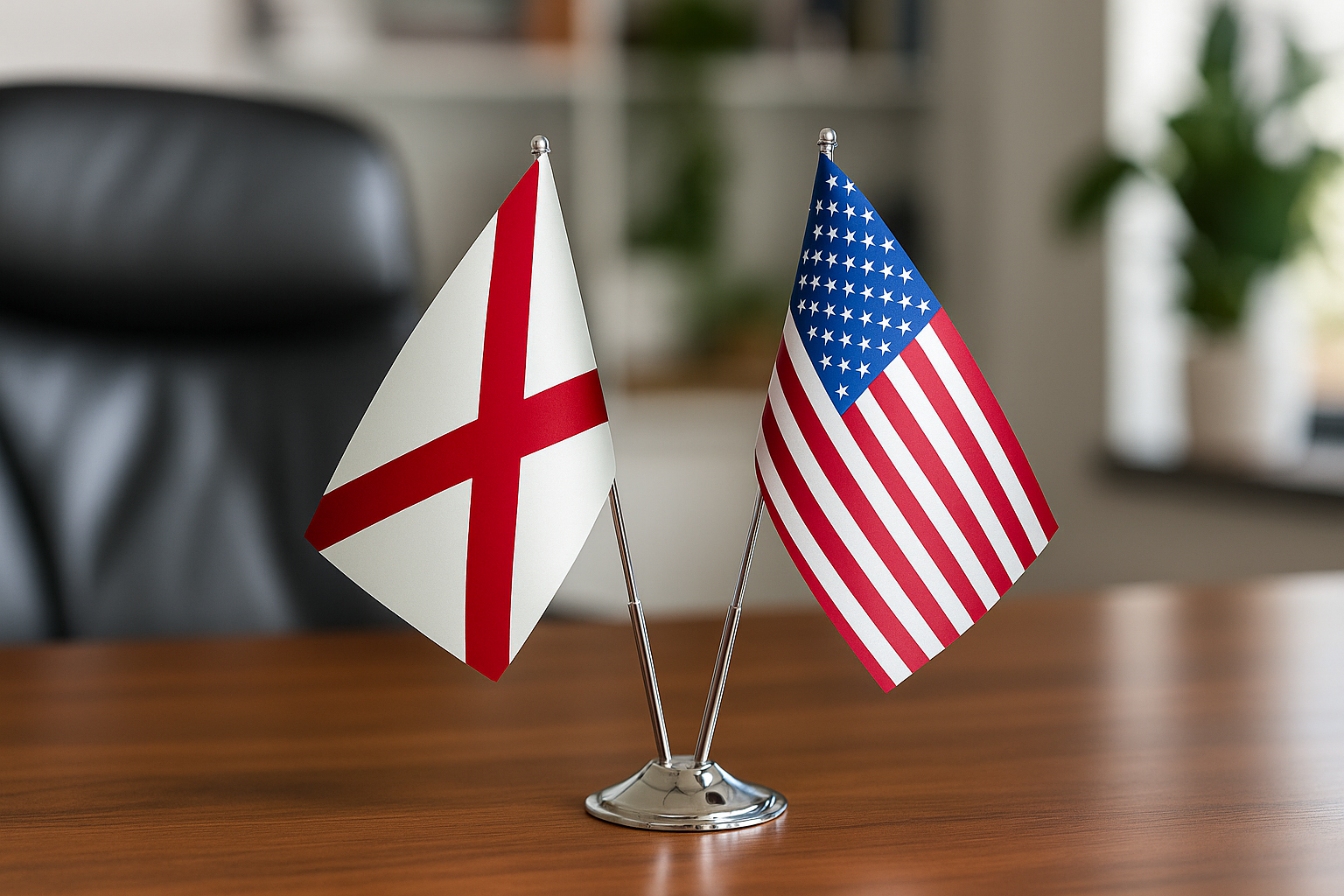
 When pairing a Hawaii flag with a U.S. flag in an indoor ceremonial setting, US Flag Code (4 USC § 7) requires the American flag to occupy the position of honor — to the right of the speaker, which is stage left from the audience's perspective. Both flags should be the same size on the same height poles; using different sizes creates a protocol violation and an asymmetric visual. The Hawaii & U.S. Desk Flag Set solves this at desktop scale by providing both flags on matching silver chrome or gold poles, so the pairing is already balanced. For larger ceremonial installations — a conference room, a legislative chamber, or a hotel lobby — the same matching-size principle applies, and both the Hawaii Official Indoor Flag and the companion U.S. flag should be sourced at identical dimensions. If you are also planning a display event, the Hawaii Flag Displays for Homes, Shops and Luaus guide covers positioning and quantity planning in detail.
Indoor, Outdoor and Desk Hawaii Flag Sizes Compared
Here is a practical side-by-side reference for the three main Hawaii flag formats:
- Desk flags: 4 in × 6 in (10 cm × 15 cm) — standard office, classroom, or reception desk. The Hawaii State Desk Flag fits this format and is built from double-layer satin with dye-sublimation printing for sharp stripe and canton detail at close viewing distances.
- Small indoor ceremonial: 2 ft × 3 ft (61 cm × 91 cm) — suitable for a small office, classroom corner display, or a tabletop pole stand taller than a standard desk flag holder.
- Standard indoor ceremonial: 3 ft × 5 ft (91 cm × 152 cm) — the most common government and institutional format; pairs with a 7.5 ft to 9 ft (229 cm to 274 cm) floor-standing pole and spear or eagle finial.
- Standard outdoor: 3 ft × 6 ft (91 cm × 183 cm) — residential flagpoles of 15 ft to 20 ft (457 cm to 610 cm); light commercial use.
- Large outdoor: 4 ft × 8 ft (122 cm × 244 cm) — commercial flagpoles of 25 ft to 30 ft (762 cm to 914 cm); municipal buildings and hotel entrances.
- Extra-large outdoor: 5 ft × 10 ft (152 cm × 305 cm) — poles of 35 ft to 40 ft (1067 cm to 1219 cm); arenas, convention centers, and waterfront displays.
Raschel knitted polyester fabric — available at 110 to 220 g/m² — is the standard choice for outdoor Hawaii flags because its open weave reduces wind resistance, extending flag lifespan to 6 months to 2 years depending on exposure. Indoor ceremonial flags use satin (100 to 165 g/m²) for a smooth, lustrous finish that photographs well and reads cleanly under artificial lighting. Desk flags also use satin for the same reason: the flag is always viewed up close.

State and City Indoor Flags
Official-grade indoor flags for all 50 states, designed for government halls, institutions, and professional office environments where protocol and print quality matter.
Browse Collection →Sizing Mistakes That Make a Hawaii Flag Look Wrong
The single most common mistake is selecting a flag that is too small for the pole — a 2 ft × 3 ft (61 cm × 91 cm) flag on a 25 ft (762 cm) pole looks lost and reads as an afterthought rather than a deliberate display. The second most frequent error is ignoring the 1:2 ratio when ordering custom or non-standard sizes; a flag printed at 3 ft × 4 ft (91 cm × 122 cm) will compress the eight stripes horizontally and distort the Union Jack canton's proportions, making it look incorrect to anyone familiar with the design. Always confirm the aspect ratio before ordering.
A third mistake specific to Hawaii's flag is under-specifying print resolution for the canton detail. The Union Jack contains diagonal lines (the saltires of St. Andrew and St. Patrick) that must register at tight angles; on a low-resolution or screen-printed flag, those diagonals can appear as blurry gray bands rather than crisp red and white crosses on blue. This is why dye-sublimation printing on satin — as used for the Hawaii Official Indoor Flag — is the recommended method for indoor ceremonial displays where viewers are within 3 ft to 10 ft (91 cm to 305 cm) of the flag. For a broader comparison of how state flags handle size selection, the Alaska Flag for Cabins, Boats and Statehood Day article walks through the same decision framework for another distinctive state design.
Hawaii Flag Sizes for Specific Venues and Occasions
Different venues call for different size strategies, and Hawaii's design scales gracefully across all of them. For a government office or legislative chamber, a 3 ft × 5 ft (91 cm × 152 cm) flag on a 9 ft (274 cm) chrome pole with an eagle finial is the standard ceremonial format; this is exactly the configuration of the Hawaii Official Indoor Flag. For a hotel lobby or convention center, 4 ft × 8 ft (122 cm × 244 cm) outdoor-grade flags on 30 ft (914 cm) exterior poles create a welcoming statement visible from the street. For a classroom, a 2 ft × 3 ft (61 cm × 91 cm) tabletop or wall-mount flag strikes the right balance between visibility and room scale.
For desk displays — the most personal and high-traffic format — the 4 in × 6 in (10 cm × 15 cm) desk flag is universally recognized as the professional standard. Pairing it with a matching U.S. flag on the same desk communicates both state and national pride simultaneously, and the Hawaii & U.S. Desk Flag Set handles both on matching poles so the display requires no additional sourcing. If you are sizing flags for an event like Lei Day or Hawaiian statehood celebrations, the Hawaii Flag Displays for Homes, Shops and Luaus article covers quantity planning and positioning in detail — topics this sizing guide deliberately keeps brief.
What are the official dimensions of the Hawaii state flag? +
Why does the Hawaii flag have eight stripes instead of a different number? +
What size Hawaii flag fits a standard 20 ft residential flagpole? +
Where can I buy an official-quality Hawaii state flag for an indoor government setting? +
What is the correct stripe order on the Hawaii flag from top to bottom? +
How large should a Hawaii desk flag be for a professional office? +
Does the aspect ratio change how the Union Jack canton looks on the Hawaii flag? +
Choosing the right Hawaii flag size means matching your pole height, viewing distance, and venue type to the standard size options — and ensuring the aspect ratio, stripe width, and canton detail are faithfully reproduced at whatever scale you choose. For institutional and ceremonial settings, the Hawaii Official Indoor Flag delivers government-grade quality on a chrome pole with high-definition sublimation printing. For desk displays, the Hawaii State Desk Flag and the Hawaii & U.S. Desk Flag Set cover both single-state and paired national formats. Explore the full USA State Desk Flags collection for matching formats across all 50 states. Bulk pricing is available for corporate, government, and institutional orders — contact us directly for volume quotes.


