







The New Jersey state flag is buff (a warm tan-yellow) with the state coat of arms centered on it — not blue, not gold, but specifically buff, a color George Washington himself requested for the state's Revolutionary War uniform facings. If you're a government office, school, or business choosing or displaying this flag, understanding both its design requirements and the display rules that govern it is essential. You'll find compliant options across our US State Flags collection, which covers indoor and outdoor formats in multiple sizes.
 The buff background is what makes the New Jersey flag immediately recognizable and legally distinct. Adopted on March 26, 1896, New Jersey's flag features the state coat of arms centered on a buff field — a decision that traces directly to the Continental Army, when New Jersey troops wore buff-colored uniform facings under Washington's command. The coat of arms depicts a helmet above a blue shield bearing three plows, flanked by a horse on each side, with the state motto "Liberty and Prosperity" on a ribbon below and the goddess Liberty and the goddess Ceres standing as supporters on either side. Getting the buff hue right on a physical flag matters enormously: a flag printed with yellow, beige, or cream instead of the prescribed buff will not meet official state standards, which is why high-definition sublimation printing — the method used for our New Jersey Official Indoor Flag — is the preferred approach for institutional display where color fidelity is non-negotiable.
What the US Flag Code Says About Flying State Flags
Under 4 USC §§ 1–10, the US Flag Code establishes the precedence of the national flag over all other flags on American soil — state flags included. The New Jersey flag, like every other state flag, must yield to the Stars and Stripes in matters of position, height, and prominence whenever they are displayed together. The Code does not regulate the internal design of state flags or mandate which state flags must be flown, but it sets the framework within which state and local rules operate. New Jersey's own statutes (N.J.S.A. 52:3-1 through 52:3-4) define the official flag design and authorize its display, but they defer to federal precedent on matters of multi-flag protocol.
When the US flag and the New Jersey flag are flown from separate staffs of equal height — a common arrangement at state buildings, courthouses, and schools — the national flag must occupy the position of honor, which is to the flag's own right, or the observer's left. If a single building flies multiple flags on a horizontal line, the US flag goes to the marching right of all others. State flags should never be placed higher than the national flag, and no foreign flag may fly equal to or above the US flag on American soil except during times of international peace and by mutual agreement. These rules apply whether you are flying a 3×5 ft (91×152 cm) outdoor flag on a standard 20 ft (6 m) residential pole or a larger 6.5×10 ft (200×300 cm) flag on an institutional campus flagpole.
How to Position the New Jersey Flag Correctly When Displayed With Other Flags
The order of precedence for multi-flag displays places the US flag first, followed by state flags, then county or municipal flags, and finally organizational or corporate flags. When New Jersey's flag is displayed alongside flags of other states — common at conference centers, legislative buildings, and airports — states are typically arranged alphabetically or in the order of their admission to the Union. New Jersey was the third state to ratify the Constitution (December 18, 1787), so it precedes most other state flags in admission-order arrangements. On a stage or podium setting, the US flag is placed to the speaker's right (the audience's left), and the New Jersey flag goes to the speaker's left; no other flag should appear between them or above either staff.
 For outdoor installations, the physical flag itself must be sized appropriately relative to the flagpole height. A general industry guideline holds that flag length should be approximately one-quarter to one-third of the pole height: a 20 ft (6 m) pole suits a 3×5 ft (91×152 cm) flag, while a 25 ft (7.6 m) pole handles a 4×6 ft (122×183 cm) flag comfortably without wrapping or sagging. Our New Jersey State Outdoor Flag is made from 110 g/m² Raschel knitted polyester and comes in eight sizes, from 1.6×2.5 ft (50×75 cm) up to 6.5×10 ft (200×300 cm), so you can match the flag to the pole precisely rather than defaulting to a one-size-fits-all approach. Raschel knitted polyester is wind-permeable, which reduces stress on the pole hardware and extends the flag's service life — typically 6 months to 2 years depending on wind exposure and UV intensity. For vertical pole installations on building facades or narrow entrances, the New Jersey State Vertical Flag in 110 g/m² Raschel is purpose-built for that orientation, available in four sizes from 1.6×6.5 ft (50×200 cm) to 3.3×13 ft (100×400 cm).
Display Practices That Violate Protocol for the New Jersey Flag
Several common display mistakes violate either the US Flag Code or accepted flag etiquette standards — and some apply specifically to the New Jersey flag's distinctive design. The most frequent error is color inaccuracy: displaying a yellow-gold or cream-colored flag instead of the prescribed buff field misrepresents the official state symbol. Buff is a specific warm tan, historically linked to undyed wool, and it is codified in New Jersey's official flag statute. A second common violation is placing the New Jersey flag higher than or equal to the US flag on the same staff — 4 USC § 7(c) explicitly prohibits this. A third error is allowing the flag to touch the ground, the floor, or water — this applies to the New Jersey flag just as firmly as to the national flag.
The US Flag Code also prohibits using any flag — state flags included — as wearing apparel, bedding, or drapery (4 USC § 8(d)), or as a receptacle for carrying objects. Using a New Jersey flag as a tablecloth at a civic event, for instance, is a protocol violation even if it seems celebratory. Flags displayed flat against a wall — a common choice for press conference backdrops and legislative chambers — should be oriented so that the union of the US flag (or in this case, the coat of arms of the New Jersey flag) is at the top left from the observer's perspective. A flag displayed in a window must follow the same orientation rule. Worn, faded, or torn flags should be retired respectfully; most American Legion posts in New Jersey accept state flags for ceremonial retirement alongside national flags.
Half-Staff and Ceremonial Rules That Apply to the New Jersey Flag
The New Jersey state flag must be flown at half-staff whenever the US flag is ordered to half-staff by presidential proclamation, and also when the Governor of New Jersey issues a separate executive order for state-specific occasions — the death of a sitting or former governor, a state judge, or a victim of a tragedy affecting New Jersey specifically. Under 4 USC § 7(m), the President may order half-staff displays for the death of principal figures of the government or distinguished Americans; the Governor's authority runs parallel for state buildings. When flying at half-staff, the flag is first raised briskly to the peak and then lowered ceremonially to the half-staff position, and it is raised again to the peak before being lowered at the end of the day.
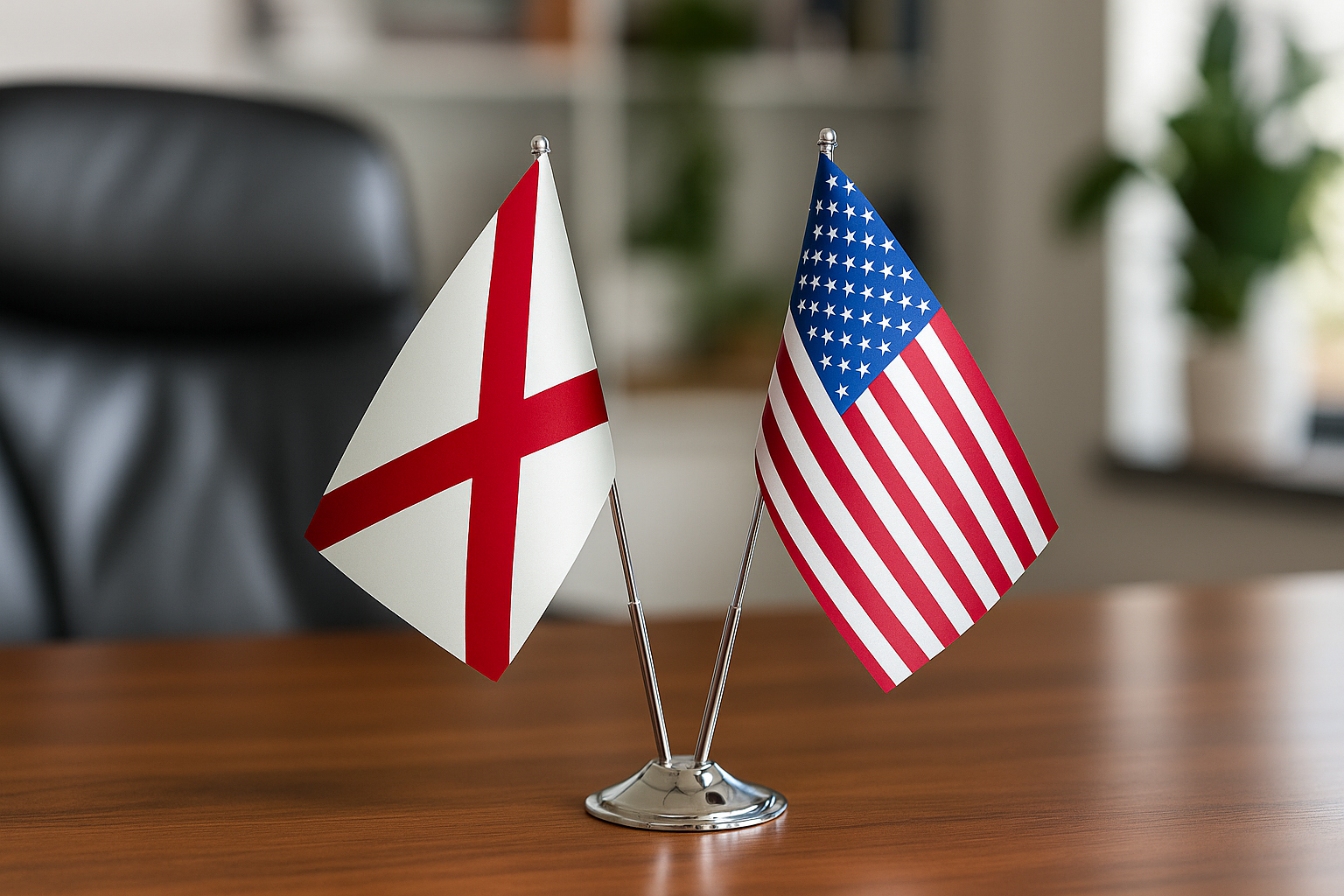
Ceremonial occasions — New Jersey Day, state legislative openings, public memorial events — often call for indoor flag arrangements alongside the US flag. For these settings, an indoor presentation flag on a chrome metal pole is standard protocol. The flag should not be draped over furniture, used as a backdrop curtain, or pinned flat to a soft surface without a rigid backing. When the New Jersey flag is carried in a parade or color guard, it follows immediately after the US flag in order of precedence, carried to the left of the national colors from the marching unit's perspective. If multiple state flags are carried, New Jersey's position as the third state admitted gives it an early place in admission-order processions.
A Practical Display Checklist for Institutions Flying the New Jersey Flag
Government offices, schools, courthouses, and businesses that fly the New Jersey flag can use the following checklist to stay compliant with both federal and state display rules at all times.
- Color accuracy: Confirm the flag's background is buff — warm tan — not yellow, gold, or cream. Request a color proof or sample swatch before ordering large quantities.
- Flag-to-pole ratio: Match flag size to pole height (approximately ¼ to ⅓ of pole height in flag length). Do not fly an undersized flag on a tall pole or an oversized flag on a short one.
- Precedence position: Place the US flag in the position of honor (flag's own right on equal-height staffs). The New Jersey flag goes to the left of the national flag from the observer's perspective.
- Admission order: When displaying multiple state flags, position New Jersey in the third slot if using order-of-admission sequencing.
- Half-staff monitoring: Subscribe to the New Jersey Governor's Office announcements and the American Flag Foundation's alerts to ensure timely half-staff compliance.
- Indoor orientation: Flags displayed flat against walls must have the coat of arms positioned at the top left from the observer's view.
- Retirement schedule: Inspect outdoor flags every 90 days. Flags showing significant fading (color shift away from buff), fraying along the fly end, or torn canton should be retired and replaced.
- Handheld flags at events: For civic events, rallies, and school activities, handheld stick flags in 90 g/m² Raschel polyester — available in packs from 50 to 1,000 — are a practical and cost-effective way to distribute official-colored flags without protocol concerns about treatment or retirement.

US State Flags
Every US state flag in outdoor, indoor, vertical, and handheld formats — sized and printed to official specifications for institutions, businesses, and home display.
Browse Collection →Protocol compliance matters most when institutions are on record — legislative halls, courtrooms, and governor offices are photographed constantly, and a flag with the wrong buff shade or the wrong position in a multi-flag lineup reflects poorly on the institution. For offices that need guidance on sizing across different states, our article on Florida flag sizes and state seal placement covers sizing logic that applies broadly, and our piece on Texas flag sizes for homes, ranches, and businesses addresses the same pole-to-flag ratio questions that New Jersey institutions face.
For institutions and businesses ready to order, the New Jersey Official Indoor Flag on a chrome metal pole is the right choice for legislative and ceremonial settings, while the New Jersey State Outdoor Flag in 110 g/m² Raschel polyester covers standard flagpole applications in eight sizes. For narrow vertical installations, the US State Vertical Flags collection offers building-front formats purpose-built for that use case. Bulk pricing is available for corporate, municipal, and institutional orders — contact us directly for volume quotes.


