







Setting up outdoor flags correctly at city halls, county courthouses, and municipal buildings requires more than simply raising a banner on a pole — it demands compliance with federal sizing standards, state-specific protocols, and procurement efficiency for public budgets. Whether you manage a single city hall or oversee procurement for an entire county system, understanding the right flag dimensions, flagpole ratios, and material specifications will keep your installation looking professional, legally compliant, and built to last. This guide covers everything procurement officers, facilities managers, and municipal administrators need to know, from USA outdoor flags for government buildings to bulk ordering strategies that stretch every taxpayer dollar.
Federal Flag Display Standards Every Municipal Building Must Follow
Municipal buildings are legally and symbolically obligated to follow the U.S. Flag Code (4 USC §§ 1–10), which governs how the American flag is displayed, positioned, and maintained on government property. The Flag Code specifies that when the U.S. flag is flown on a flagpole, it must occupy the position of highest honor — center and tallest on multi-pole installations — and must never be displayed in a deteriorated or faded condition. While the Code does not carry criminal penalties for most violations, failure to comply can attract public criticism and, in some states, local ordinance enforcement. Many state statutes, including those in Texas, Florida, and California, layer additional requirements on top of federal guidelines for county courthouse outdoor flag displays, making it essential that facilities managers review both federal and state rules before finalizing any installation.
For multi-flag arrays — common at city halls where the U.S. flag, state flag, and municipal flag may all fly together — the American flag must be at the center and highest point when three or more flags are on adjacent poles of equal height. When poles are of unequal height, the national flag goes on the tallest. The FIAV (Fédération Internationale des Associations Vexillologiques) recommends proportional consistency across an installation, meaning if you fly a 4 ft × 6 ft (122 cm × 183 cm) American flag, your state and city flags should match that size to maintain visual symmetry. Non-compliance with these display protocols at a courthouse outdoor flag display is not just an aesthetics issue — it signals institutional disregard for national symbols.
Government Building Flag Size Guide: Matching Flag to Flagpole Height
The correct flag size for a government building is determined primarily by flagpole height, with the standard rule being that flag length should equal approximately 25–33% of the flagpole height. This ratio ensures the flag is visible and proportionate without appearing overwhelmed by the pole or hanging limply. Below is a practical sizing reference for the most common municipal flagpole configurations:
- 20 ft (6.1 m) pole: 4 ft × 6 ft (122 cm × 183 cm) flag — ideal for smaller municipal offices and branch facilities
- 25 ft (7.6 m) pole: 5 ft × 8 ft (152 cm × 244 cm) flag — standard for city hall entrances and library forecourts
- 30–35 ft (9.1–10.7 m) pole: 6 ft × 10 ft (183 cm × 305 cm) flag — recommended for county courthouse outdoor flag displays
- 40 ft (12.2 m) pole: 8 ft × 12 ft (244 cm × 366 cm) flag — suitable for major civic plazas and government campus entries
- 60 ft (18.3 m) pole: 10 ft × 15 ft (305 cm × 457 cm) or 12 ft × 18 ft (366 cm × 549 cm) flag — for large federal and state government complexes
A USA outdoor flag 3×5 for government settings is typically reserved for smaller supplementary poles, interior courtyard displays, or ceremonial temporary installations rather than main-entrance flagpoles. The 3 ft × 5 ft (91 cm × 152 cm) size is most appropriate for poles in the 15–20 ft (4.6–6.1 m) range. Procurement officers should also note that the U.S. government's own General Services Administration (GSA) publishes flag size specifications for federally leased buildings, which can serve as a useful benchmark even for local municipalities.
Material and Durability Standards for Outdoor Municipal Flags
 Outdoor flags for municipal buildings must withstand continuous exposure to UV radiation, wind, rain, and temperature extremes — conditions that will quickly degrade inferior materials and create costly replacement cycles. For most U.S. climates, two-ply woven nylon with a minimum 200-denier thread count is the industry benchmark for government outdoor flags, offering a balance of wind resilience, color retention, and weight. High-quality nylon flags treated with 80% UV-resistant dye can maintain acceptable color fidelity for 6 to 12 months of continuous outdoor display before replacement is warranted, while heavier SolarMax nylon or woven polyester variants can extend service life to 12–24 months in moderate climates. Brass grommets (minimum #2 brass, 15/16 in / 24 mm diameter) are essential at the header for municipal applications because they resist corrosion and maintain secure attachment under sustained winds exceeding 25 mph (40 km/h). Reinforced canvas headers sewn with a minimum of 4 rows of lock-stitching significantly reduce tearing at the attachment point, which is the most common point of failure on high-cycle government flagpoles. Facilities teams sourcing bulk American flags for government use should request material specification sheets from suppliers and verify that colors match the Pantone Matching System (PMS) standards: PMS 193 C for Old Glory Red and PMS 281 C for Old Glory Blue, as specified in Executive Order 10834.
Coastal installations — particularly relevant for courthouses and city halls in Florida, Texas Gulf Coast, California, and the Pacific Northwest — demand additional specifications. Salt air accelerates metal corrosion and fabric degradation, making marine-grade polyester with a solution-dyed finish the preferred choice for shoreline municipal buildings. Solution-dyed polyester achieves up to 2 years of outdoor service life in coastal conditions versus 6–8 months for standard nylon. Wind-perforated mesh flags are another option for high-wind zones, reducing wind load on the flag and flagpole hardware by up to 30%, which also extends the life of the flagpole halyard system. For inland high-altitude locations common in mountain-state counties, UV exposure is the primary concern, and UV-stabilized fabrics with a minimum 80-hour Xenon Arc test rating per ASTM G155 are recommended.
City Hall Flagpole Setup: Hardware, Positioning, and Installation Best Practices
 A proper city hall flagpole setup begins with the foundation: commercial-grade aluminum or fiberglass poles should be set in concrete footings that extend below the frost line — typically 3–4 ft (91–122 cm) in northern states and a minimum of 2 ft (61 cm) in southern states — with a pole butt depth equal to approximately 10% of the pole's overall height plus 2 ft (61 cm) as a baseline rule. Internal halyard systems with locking access doors are strongly recommended for government installations because they prevent unauthorized flag changes, vandalism, and halyard theft, which are documented concerns at public civic buildings in high-traffic urban areas. External halyard cleat systems are less expensive but require anti-wrap and anti-theft cleat covers to meet security standards at sensitive government sites. The flagpole finial — typically an eagle, ball, or spear — must be secured with a locking set screw to prevent removal, and all hardware including cleats, snaps, and rings should be marine-grade stainless steel (316 SS) or solid brass to prevent corrosion-related failures that require expensive maintenance calls. Explore our complete flagpoles and accessories collection for hardware components that meet commercial government installation standards.
Positioning guidelines under 4 USC § 7 require that when displayed from a staff projecting from a windowsill, balcony, or front of a building, the union of the flag should be placed at the peak of the staff unless the flag is at half-staff. For multi-pole arrays common at county courthouses, poles should be evenly spaced with a minimum clearance of 3 ft (91 cm) between flag edges when fully extended to prevent tangling. Ground-set poles should be positioned so the flag clears all architectural elements and landscaping features by at least 2 ft (61 cm) on all sides. Lighting is a critical component that is often overlooked: 4 USC § 6(a) permits 24-hour display of the American flag when it is "properly illuminated during the hours of darkness," and LED spotlights with a minimum 1,500-lumen output directed at the flag face meet this requirement for most residential-scale poles up to 25 ft (7.6 m), while taller poles require 3,000+ lumen uplighting.
Bulk Ordering Strategy for Wholesale Flags for Municipalities
Wholesale flags for municipalities should be procured through a structured annual or biannual replacement cycle rather than reactive purchasing, which reduces per-unit costs by 20–40% and eliminates the operational disruption of emergency flag replacements. A well-structured municipal flag procurement plan accounts for the number of active flagpoles across all facilities, estimated service life per flag based on local climate data, and a 15–20% buffer stock for ceremonial replacements and storm damage. For a county system managing 12–15 courthouse and municipal building locations, a typical annual procurement might include 36–50 outdoor American flags, 12–15 state flags, and varying quantities of municipal and departmental flags.
Flagpoles & Accessories Collection
Everything a municipal facilities team needs for a complete, code-compliant outdoor flag installation — from commercial-grade poles to marine-stainless hardware.
Browse Collection →When evaluating vendors for bulk American flags for government procurement, request GSA Schedule pricing or equivalent tiered volume discounts, and verify that the supplier can provide a Certificate of Origin confirming domestic manufacturing if your jurisdiction requires Buy American compliance under the Buy American Act (41 USC §§ 8301–8305). Purchase order contracts with scheduled quarterly deliveries are preferable to single large orders because they distribute storage requirements, ensure fresher flag stock, and allow adjustments based on actual replacement rates. Confirm that your supplier maintains consistent dye lots across production runs so that flags purchased in March and October display matching colors — a visible inconsistency that reflects poorly on government installations. For custom municipal flags, printed logo flags, and branded outdoor pole flags for city branding initiatives, explore the logo-printed outdoor pole flags collection, which supports custom artwork, Pantone color matching, and bulk pricing for government clients.
Indoor Display Considerations for Government Lobbies and Council Chambers
Indoor government flag displays — in council chambers, courtrooms, and municipal lobbies — require a separate set of standards from outdoor installations and are an important complement to any comprehensive government building flag program. For indoor use, the American flag is typically displayed on a ceremonial flagpole or presentation staff to the speaker's right (audience's left) per standard protocol derived from military and congressional practice, with the state flag positioned to the speaker's left. Presentation flag sets for council chambers typically use 8 ft (244 cm) or 9 ft (274 cm) indoor staffs with spear or eagle finials, carrying 3 ft × 5 ft (91 cm × 152 cm) or 4 ft × 6 ft (122 cm × 183 cm) flags in a heavier indoor fabric such as poly/cotton blend or rayon for a formal draping appearance. Browse the complete indoor flags collection for presentation-quality options suited to government interiors.
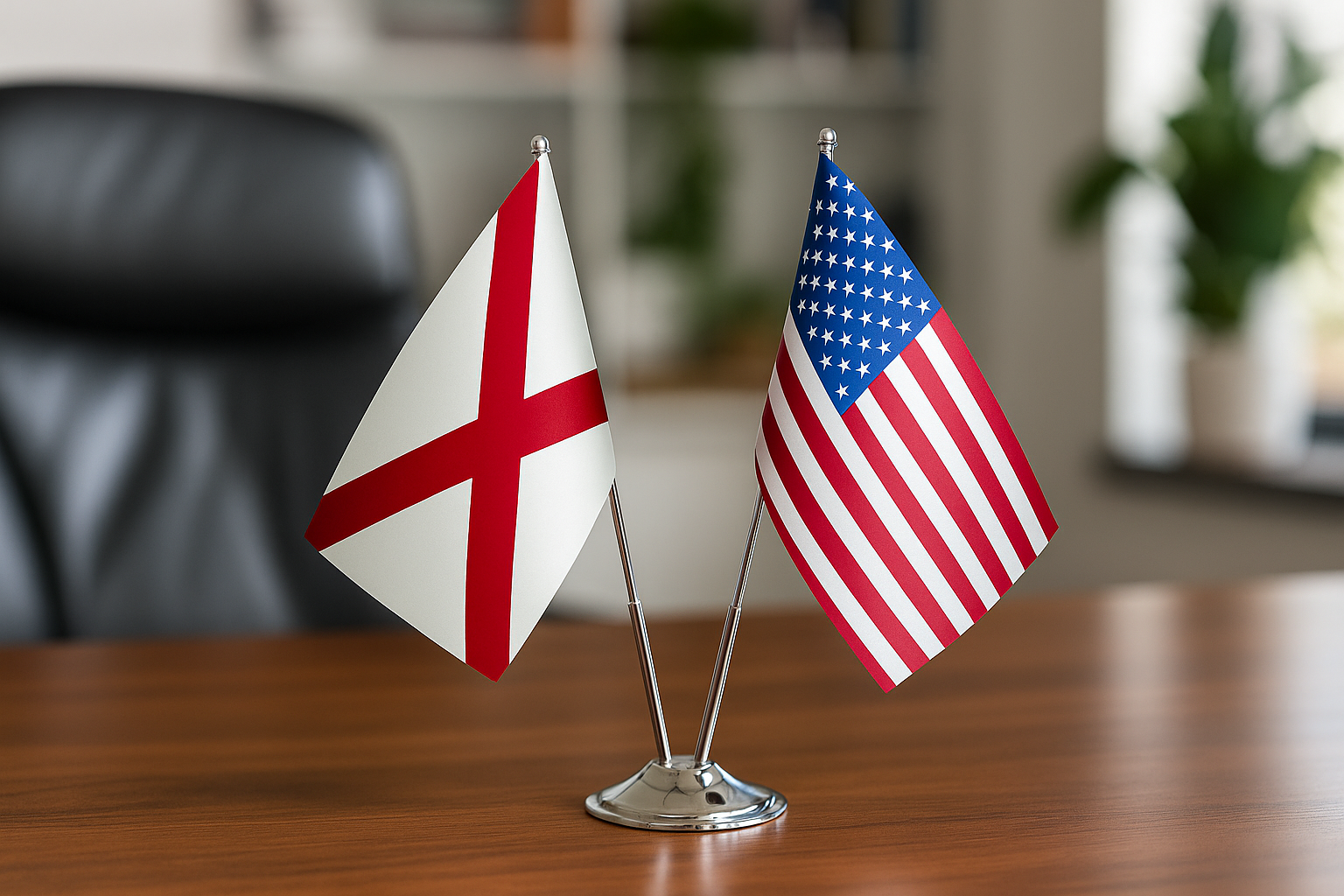
For desk and counter displays in reception areas, permit offices, and administrative counters, a weighted metal desk flag stand presents a professional and dignified appearance. The luxury chrome gold desk flag stand with premium weighted metal base is available in single through five-flag configurations, making it well-suited for multi-flag government desk displays where the national, state, and municipal flags are presented together at a reception desk or official's workspace. For state and city-specific indoor flags to pair with these display systems, the state and city indoor flags collection offers a comprehensive range of presentation-quality options. Maintaining consistency between indoor and outdoor flag quality reinforces the institutional professionalism of the municipal building as a whole.
Frequently Asked Questions
What flag size is required for a 30-foot flagpole at a county courthouse? +
How often should outdoor flags at municipal buildings be replaced? +
Does the Buy American Act apply to government flag purchases? +
What is the correct order of flags on a three-pole setup at a city hall? +
What flag material is best for government buildings in coastal areas? +
Can municipalities order custom logo flags for outdoor pole display? +
Is a 3x5 USA flag appropriate for a government building's main flagpole? +
For procurement officers and facilities managers ready to equip government buildings with code-compliant, weather-ready outdoor flag systems, Asya Bayrak offers a comprehensive range of options built for the demands of public-sector display. Start with the USA Outdoor Flag product page for American flags in all standard government sizes, then build out your complete installation with the flagpoles and accessories collection for hardware that meets commercial installation standards. For city branding initiatives and municipal identity programs, the logo-printed outdoor pole flags collection supports fully custom designs with Pantone-matched colors and bulk production runs. Bulk pricing is available for corporate and government orders — contact the Asya Bayrak procurement team to discuss standing purchase agreements, GSA-comparable volume pricing, and scheduled delivery contracts tailored to your municipality's annual flag replacement cycle.


