




The Zimbabwe Bird on the national flag is a soapstone carving of a fish eagle — a symbol of national identity, sovereignty, and the ancient civilization of Great Zimbabwe — rendered in gold on a red star within a white triangle at the hoist. If you are researching Zimbabwe's national symbols or looking to display the flag with accuracy, exploring our full Country Flags collection is a practical starting point for official-grade reproductions.
What the Zimbabwe Bird and Flag Colors Actually Mean
The Zimbabwe Bird represents the historic greatness and continuity of the Zimbabwean people, drawn from the soapstone bird figurines excavated at the Great Zimbabwe ruins — one of Africa's most significant archaeological sites. Each color on the flag carries a precise, codified meaning: green stands for the country's agriculture and rural land; yellow represents the nation's mineral wealth, particularly gold; red commemorates the blood shed during the liberation struggle; black symbolizes the heritage and majority population of Zimbabwe; and white stands for peace. The red star on which the bird perches signals the nation's aspirations toward socialism and a progressive future. Taken together, the flag is not decorative shorthand — every element is a deliberate political and cultural statement ratified at independence.
How the Zimbabwe Flag Came to Look the Way It Does
Zimbabwe's current flag was adopted on April 18, 1980, the day the country gained independence from minority-ruled Rhodesia and formally became Zimbabwe. Before independence, the territory had flown the British colonial flag and then the green-and-white Rhodesian flag, neither of which acknowledged the African majority's culture or history. The new flag was designed to break cleanly from that colonial visual language and assert a sovereign African identity rooted in the ruins of the medieval Kingdom of Zimbabwe, which flourished roughly between the 11th and 15th centuries CE. The Zimbabwe African National Union–Patriotic Front (ZANU-PF), led by Robert Mugabe, was central to selecting the symbols, and the design went through committee review before being codified in the Zimbabwe Citizenship Act and subsequent flag legislation. The seven horizontal stripes — green, yellow, red, black, red, yellow, green — are arranged symmetrically around the central black band, giving the flag a deliberate, balanced geometry that distinguishes it from other African tricolor designs.
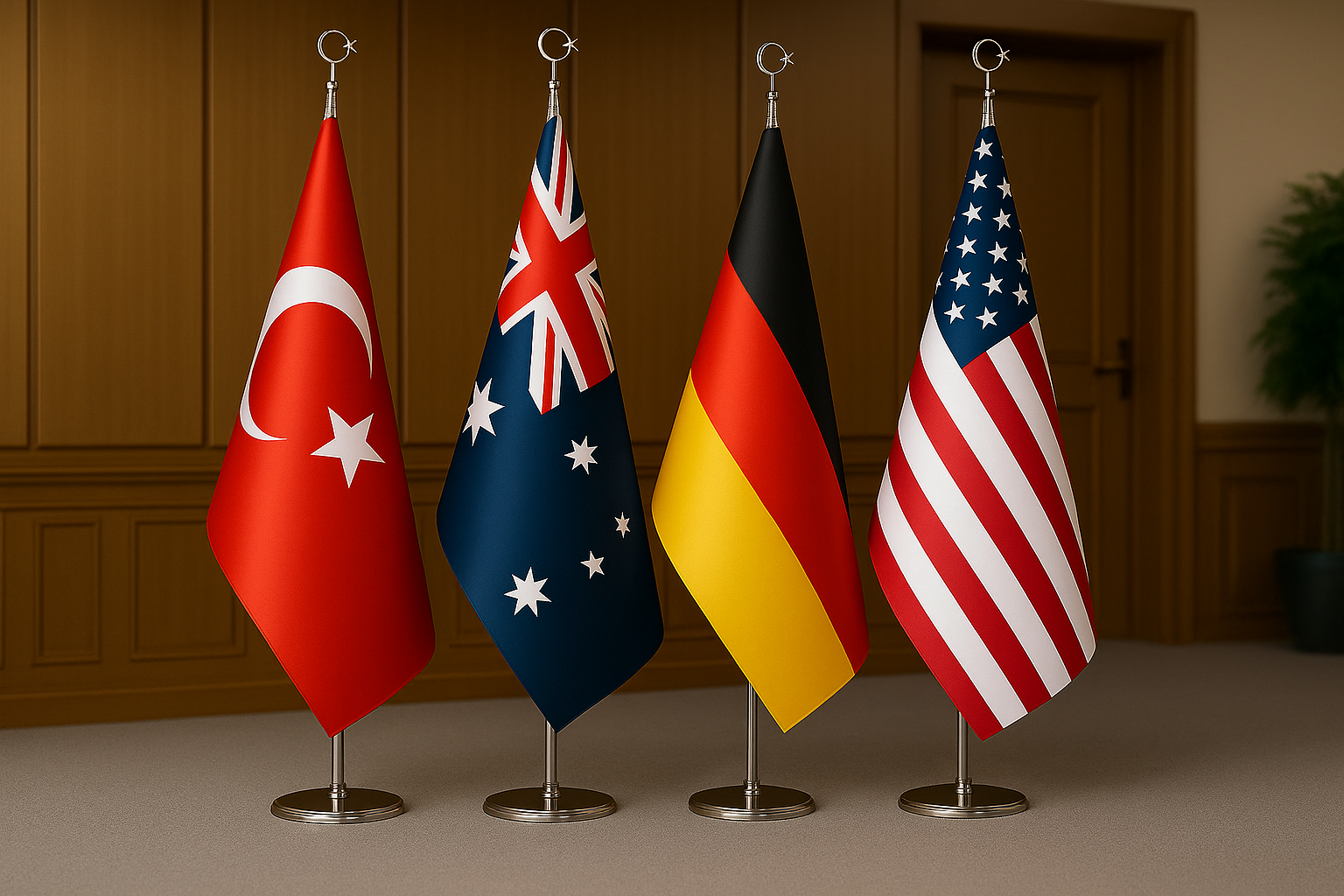
 For settings where the Zimbabwe Bird must be reproduced with the highest fidelity — embassies, diplomatic missions, government offices, and institutional ceremonies — a dedicated indoor flag format is the appropriate choice. Our Zimbabwe Official Indoor Flag uses high-definition sublimation printing on double-layer satin fabric, mounted on a durable chrome metal pole, ensuring that every stripe, star, and bird detail reads with clarity at close range. The satin fabric used is available in 100, 150, and 165 g/m² weights, which provide the drape and sheen expected in formal indoor settings. This level of reproduction matters particularly for the bird motif, where fine line details in the wing feathers and posture can be lost on lower-quality prints. Choosing a flag printed specifically for indoor ceremonial use means the colors remain true under artificial lighting and the design does not fade with repeated unrolling and display.
Where the Zimbabwe Bird Figurines Originally Come From
The Zimbabwe Bird is modeled directly on eight soapstone sculptures discovered at the Great Zimbabwe archaeological site in the late 19th and early 20th centuries, with the most intact example now housed in the Zimbabwe Museum of Human Sciences in Harare. The figurines stand roughly 16 inches (40 cm) tall and depict a bird — widely interpreted as a fish eagle or a hybrid creature combining human and avian features — perched on a carved stone column. Scholars broadly agree that the figures served a ritual or royal purpose within the Shona-speaking Zimbabwe state, though the precise ceremonial function remains debated. The fish eagle identification is significant: the African fish eagle (Haliaeetus vocifer) is native to Zimbabwe and carries cultural weight across southern Africa as a symbol of vision, freedom, and strength. Colonial-era Rhodesia actually placed a version of the Zimbabwe Bird on its own flag and coat of arms — a historical appropriation that made the bird's prominent placement on the independent nation's flag all the more pointed as a reclamation of indigenous heritage. The bird on the current flag faces the hoist (left), a standard heraldic posture indicating readiness and forward direction.
Flags That Look Similar and How to Tell Them Apart
The Zimbabwe flag is sometimes confused with the Mozambique flag, and less often with the flag of Guinea-Bissau, primarily because all three feature bold horizontal stripes in red, black, yellow, and green alongside a hoist-side triangle or vertical band. The clearest distinguishing feature is Zimbabwe's seven-stripe symmetrical layout and the white triangle containing a red star with the gold Zimbabwe Bird — Mozambique uses a red triangle with a Kalashnikov rifle, open book, and hoe, making the two unmistakable once you know what to look for. The Kenyan flag also shares red, black, and green bands but arranges them as three horizontal stripes with a Maasai shield, bearing no structural resemblance to Zimbabwe's design beyond a shared palette. For vexillologists referencing FIAV (Fédération Internationale des Associations Vexillologiques) standards, Zimbabwe's flag is documented with the civil, state, and war flag all sharing the same design, which is common among African republics. If you are producing or purchasing flags for a multicultural event and need to distinguish several southern and eastern African nations, the stripe count and hoist emblem are the fastest reference points.
 When flying the Zimbabwe flag outdoors — at community centers, sports venues, cultural events, or residences — fabric durability and color vibrancy become the primary concerns, particularly in high-UV environments. Our Zimbabwe Outdoor Flag is crafted from 90 g/m² Raschel knitted polyester, a fabric engineered for outdoor exposure that holds color through direct printing and heat-fixing, resisting the fading that compromises the flag's seven-stripe readability over time. Raschel knit construction also allows airflow through the weave, reducing wind load on the pole and extending the flag's physical lifespan — typically 6 months to 2 years depending on wind exposure and UV intensity at the installation site. The fish eagle and red star are rendered with enough detail to remain identifiable even at standard flagpole distances of 20 to 30 ft (6 to 9 m). For anyone displaying the flag at events celebrating Zimbabwe's national holidays — such as Independence Day on April 18 or Heroes' Day in August — this outdoor format is the practical choice.
What Official Zimbabwe Flag Standards Look Like Today
Zimbabwe's national flag legislation specifies a length-to-width ratio of 2:1, meaning a flag 6 ft (1.83 m) long should be 3 ft (0.91 m) wide — the same proportion used by the United States and many Commonwealth-tradition nations. The seven horizontal stripes must be equal in width, with the white triangle occupying the hoist side and its point reaching approximately one-third of the flag's fly length. The red five-pointed star sits centered in the triangle, and the Zimbabwe Bird is placed on the star facing the hoist. Official government documents and the Zimbabwe Coat of Arms Regulations provide the authoritative color references, with green, yellow, and red approximating Pantone values used in consistent government printing — though exact Pantone codes are not always publicly specified in accessible legislation. For diplomatic and institutional use, flags should meet these proportional standards exactly; a flag that compresses the triangle or shifts the bird off-center is technically non-compliant. Anyone interested in other national flags with complex heraldic symbols on a white triangle or hoist panel may also find our article on the Broken Trident on the Barbados Flag a useful parallel read, and those curious about other bird symbols in national vexillology will appreciate our coverage of the Thunder Dragon on the Bhutan Flag.
African Countries Flags
Our African Countries Flags collection offers official-grade flags for Zimbabwe and the full continent, produced in formats suited for outdoor poles, indoor ceremonies, desks, and events.
Browse Collection →Is the Zimbabwe Bird always facing left on the flag? +
How many stripes does the Zimbabwe flag have and what order are they in? +
Did Rhodesia also use the Zimbabwe Bird on its flag? +
What fabric is best for a Zimbabwe flag displayed at an outdoor sports event? +
How many original Zimbabwe Bird soapstone figures were found, and where are they now? +
What is the correct aspect ratio for an official Zimbabwe flag? +
Is there a desk flag option for displaying Zimbabwe in an office or on a conference table? +
Whether your interest in the Zimbabwe flag is historical, cultural, or practical, understanding the fish eagle's symbolism adds real depth to how you display or interpret this flag. For high-accuracy outdoor display, the Zimbabwe Outdoor Flag in 90 g/m² Raschel polyester delivers durability and color fidelity in equal measure. For formal institutional settings, the Zimbabwe Official Indoor Flag with sublimation-printed satin fabric on a chrome pole is the professional-grade solution. If you are coordinating a multicultural event or stocking flags for multiple African nations, browse the full African Countries Flags collection for a comprehensive range. Bulk pricing is available for corporate, embassy, and institutional orders — contact us directly to discuss volume requirements and custom sizing.


