





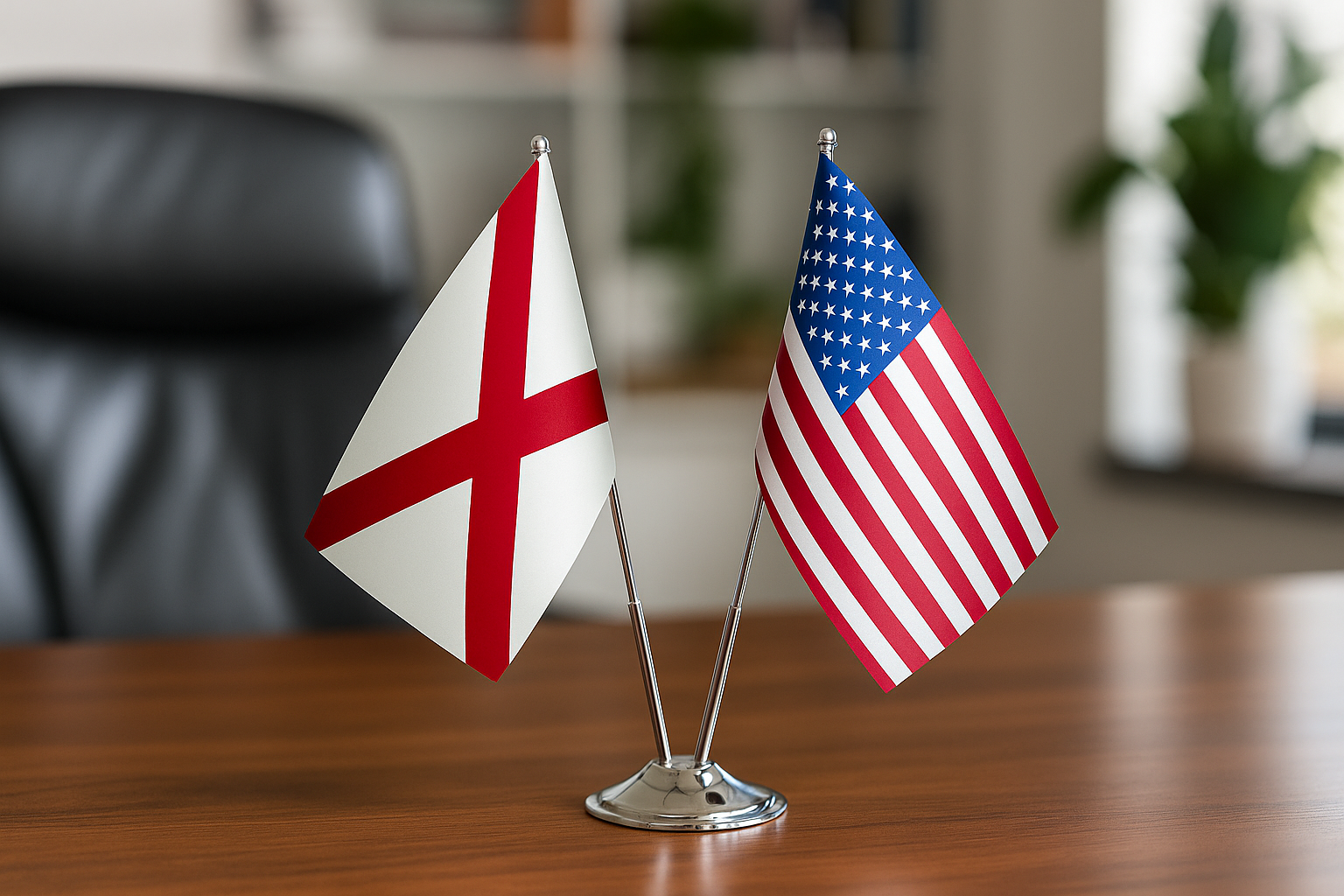




Federal agency and cabinet office indoor flag protocol requires displaying the American flag to the speaker's right (the audience's left), positioning department or seal flags to its left, and selecting nylon or polyester flags sized 3 ft × 5 ft (91 cm × 152 cm) or 4 ft × 6 ft (122 cm × 183 cm) for standard government interiors. Compliance with the US Flag Code (4 USC §§ 1–10), General Services Administration (GSA) guidelines, and individual agency directives ensures your office presents a professional, lawful, and dignified display — whether you are outfitting a single conference room or procuring bulk indoor flags for federal offices across an entire department campus.
Understanding US Government Flag Display Rules for Indoor Spaces
Indoor federal flag display is governed primarily by 4 USC §§ 1–10 (the US Flag Code) and supplemented by GSA facility management standards, which together specify position, order of precedence, and condition requirements for all flags displayed in federal buildings. The Flag Code does not prescribe criminal penalties for civilian violations, but GSA and agency internal directives carry administrative weight and are routinely audited during facility inspections.
The foundational rule is position of honor: when displayed indoors with other flags, the American flag always occupies the position to the speaker's right — which is the audience's left as they face the display. This rule applies in hearing rooms, press briefing areas, executive offices, and public lobbies alike. When a department seal flag or agency flag is displayed alongside the US flag, it stands immediately to the American flag's left (from the speaker's perspective). If a state flag is also present — common in field offices — it follows the agency flag in descending order of precedence. For cabinet-level offices that display multiple departmental flags, each additional flag steps further left, and all staffs should be of uniform height (typically 8 ft / 244 cm for floor stands in standard government rooms with 9–10 ft / 274–305 cm ceilings).
Beyond placement, the Flag Code requires that indoor flags be kept clean, undamaged, and free of fraying. GSA's facility management handbooks recommend inspecting indoor flags quarterly and replacing any flag that shows visible wear, color fading beyond acceptable limits, or structural damage to fringe or header. Maintaining a documented replacement schedule is best practice for procurement offices managing government office flag protocol across multiple sites.
Choosing the Right Flag Size for Government Office Interiors
For most federal agency conference rooms and executive offices, the standard indoor flag size is 3 ft × 5 ft (91 cm × 152 cm) mounted on an 8 ft (244 cm) pole, or 4 ft × 6 ft (122 cm × 183 cm) on a 9 ft (274 cm) pole for larger ceremonial spaces. Choosing the wrong size is one of the most common errors in indoor flag set government building procurement, and it creates visual imbalance that undermines the professional appearance agencies require.
Room dimensions should drive your size selection. For rooms under 300 sq ft (28 m²) — such as individual secretary offices or small conference rooms — a 3 ft × 5 ft flag on an 8 ft pole is proportionally correct. Rooms between 300 and 600 sq ft (28–56 m²), including standard cabinet meeting rooms and public reception areas, are best served by a 4 ft × 6 ft flag on a 9 ft pole. Large ceremonial halls, Senate or House hearing rooms, and auditoriums exceeding 600 sq ft (56 m²) often use 5 ft × 8 ft (152 cm × 244 cm) flags on 9–10 ft (274–305 cm) poles to maintain visual authority. When ordering department seal flags, match their dimensions exactly to the American flag in the same display — mismatched sizes violate the spirit of the Flag Code's equal dignity principle even if not its explicit text.
Fringe is standard on indoor ceremonial flags and is not prohibited by the Flag Code for official indoor use, though it is never used on outdoor flags. Gold fringe signals a ceremonial rather than field use context and is widely used on American flags and department seal flags in federal office interiors. Confirm that any seal flag ordered for a cabinet office uses the officially approved departmental seal artwork — agencies including the Department of Defense, Department of State, and Department of Justice each maintain artwork standards that must be followed in government-issued or government-purchased flags.
Fabric and Construction Standards for Department Seal Flags
Two-ply nylon and heavyweight polyester are the preferred materials for federal agency indoor flags because they offer the best combination of color fidelity, durability, and flame resistance required by federal building codes. Lightweight single-ply polyester is suitable for desk flags and display cases but is insufficient for floor-stand ceremonial use in high-traffic government buildings.
 For department seal flags specifically, embroidered or dye-sublimated printing on 200-denier or heavier nylon produces the sharpest seal reproduction and resists the UV exposure common in government lobbies with large windows. Indoor flags, unlike outdoor counterparts, are not exposed to rain or constant wind, which means their primary degradation factors are UV light, handling, and dry cleaning cycles — a well-maintained indoor nylon flag used in a typical federal office can last 2 to 4 years before color fading requires replacement. By contrast, a comparable outdoor nylon flag in a temperate US climate may need replacement every 6 to 12 months. When specifying materials in a bulk procurement RFQ (Request for Quotation), require a minimum colorfastness rating of 4 on the ISO 105-B02 scale and confirm compliance with CPAI-84 flame resistance standards, which are required under most federal General Services Administration building specifications. Browse the full indoor flags collection to review available construction options and fabric weights suited for government procurement.
Header construction is equally important. A doubled-and-stitched canvas header with two brass grommets is the industry standard for floor-stand indoor flags in government settings. Sleeve headers (also called pole pockets) are appropriate for flags displayed in parade stands or on wall-mounted brackets, while tab-top headers with snap hooks are the most common configuration for floor stand poles with chrome or gold eagle finials. When submitting procurement documentation, specify the exact header type to avoid receiving flags that are incompatible with existing poles and stands across your agency's locations.
Selecting Flag Poles, Stands, and Hardware for Federal Offices
The hardware surrounding an indoor flag — the pole, stand base, and finial — is as important as the flag itself for achieving a professional, regulation-compliant display in a federal government building. Agency procurement officers should specify weighted, non-tip bases and gold or chrome finials (typically an eagle) that match across all flags in a given room to present a unified, ceremonial appearance.
 For executive offices, cabinet secretary meeting rooms, and press briefing areas, a weighted metal base with a chrome or gold finish projects the gravitas these spaces demand, and the Luxury Chrome Gold Desk Flag Stand is available in single, double, triple, quad, and five-flag configurations to accommodate varying agency display requirements — from a simple two-flag American-and-agency setup to the full five-flag array seen in some multi-agency joint offices. For larger floor-stand applications, weighted crossfoot or round base designs prevent accidental tipping in high-traffic areas such as lobby reception desks and hearing anterooms. All poles used in the same room should be set to an identical height — agencies commonly specify 8 ft (244 cm) poles as the standard, with mounting mechanisms (screw-eye, gold ball, or eagle finial) matching across the entire set. Procurement officers managing agency flag stands bulk order requirements should consult the bases and stands collection and the poles and holders collection for volume pricing on compatible hardware sets.
When specifying poles, note that two-piece sectional poles (joined at mid-height) are standard for floor-stand indoor use because they ship and store more easily than one-piece poles, reducing logistics costs in large agency bulk orders. Aluminum poles with a bright chrome or gold anodized finish are preferred over wood dowels for high-traffic government environments because they resist denting, do not warp with humidity changes common in air-conditioned federal buildings, and maintain their finish through repeated flag changes over a multi-year service life.
Indoor Flags Collection
A curated range of ceremonial indoor flags sized and constructed to meet federal agency, cabinet office, and institutional display requirements.
Browse Collection →How to Configure a Complete Indoor Flag Set for a Government Building
A complete, protocol-compliant indoor flag set for a standard federal agency office consists of the American flag, the department or agency flag, the correct number of poles and weighted bases, matching finials, and — where applicable — a state flag for field offices. Ordering these components as a coordinated set rather than piecemeal procurement eliminates compatibility issues and accelerates GSA approval.
The most common indoor flag set government building configuration is a two-flag display: one American flag (4 ft × 6 ft / 122 cm × 183 cm) and one department flag of identical dimensions, each on a 9 ft (274 cm) two-piece aluminum pole with a gold eagle finial and a weighted round base. For cabinet offices that host foreign dignitaries or interagency meetings, a three-flag set adds a second agency or state flag to the left of the department flag. Press rooms and briefing areas that appear on camera — such as those in department headquarters — typically use a five-flag set to create a visually substantial backdrop, often combining the American flag, the department flag, and three additional organizational or regional flags. Consistency in finial style (all eagle or all gold ball), base finish (all chrome or all antique brass), and pole height is non-negotiable for a professional appearance on camera and during official ceremonies. Always order 10–15% additional flags as spares to cover quarterly replacements without interrupting display continuity.
Ordering Bulk Indoor Flags for Federal Agency Procurement
Federal procurement of bulk indoor flags for federal offices typically proceeds through GSA Advantage, agency-specific BPA (Blanket Purchase Agreement) vehicles, or direct micro-purchase for orders under the simplified acquisition threshold. Asya Bayrak LLC can support all three procurement pathways with compliant documentation, including product data sheets, fabric certifications, and SAM registration information.
When preparing a solicitation or purchase request for agency flag stands bulk order or a multi-location flag kit rollout, include the following specifications in your SOW (Statement of Work): flag dimensions, fabric weight and fiber content, header type, colorfastness rating, flame resistance certification (CPAI-84 or NFPA 701), seal artwork approval status, pole length and material, base weight (minimum 8 lbs / 3.6 kg recommended for stability), and finial style. Requesting samples for CO (Contracting Officer) review before full production is standard practice for custom seal flags and reduces the risk of artwork rejection. Bulk pricing tiers typically begin at 10 units per SKU, with significant per-unit cost reductions at 50, 100, and 500+ units — important for agencies equipping regional offices or executing an enterprise-wide refresh of their US government flag display across dozens of locations nationwide. Agencies procuring state and regional flags for field offices should also review the state and city indoor flags collection for GSA-compatible options.
Maintenance, Replacement Schedules, and Flag Retirement Protocol
Federal indoor flags should be inspected quarterly and replaced whenever they show fraying seams, color fading exceeding 20% from original, bent or broken grommets, or torn headers — because a deteriorated flag undermines the dignity of official spaces and may draw negative attention during VIP visits or recorded proceedings. The US Flag Code (4 USC § 8(k)) specifies that a worn or soiled flag must be destroyed in a dignified manner, traditionally by burning in a private ceremony.
For agencies managing dozens or hundreds of flag display locations, a centralized replacement tracking system is the most efficient approach. Assign each location a unique ID, record the installation date and flag condition at each quarterly inspection, and trigger an automatic reorder when a flag reaches 18 months of age regardless of visible condition — indoor flags in lobbies and briefing rooms typically reach the end of their useful ceremonial life at 18 to 24 months due to cumulative UV exposure and repeated handling. Retired American flags should be forwarded to a local VFW post or American Legion chapter for dignified retirement ceremonies; department seal flags can be archived, destroyed, or transferred per agency records management guidance. Maintaining this lifecycle documentation protects procurement officers during GSA audits and demonstrates stewardship of public resources. For outdoor flag needs at federal building perimeters and flagpoles, the USA Outdoor Flag is built for the wind, UV, and weather exposure that indoor flags are not designed to withstand.
Frequently Asked Questions
Where exactly should the American flag be placed in a federal agency office? +
What size flag is standard for a federal government office or cabinet meeting room? +
Is gold fringe on an indoor American flag allowed in government buildings? +
What fabric should department seal flags be made from for indoor federal use? +
How often should indoor flags in federal offices be replaced? +
Can federal agencies order custom department seal flags in bulk through a vendor outside GSA Advantage? +
What pole and base specifications should I include in a government flag procurement SOW? +
Do field offices need to display state flags alongside the American flag and agency flag? +
Equipping your federal agency or cabinet office with a fully compliant, professionally presented indoor flag display is a straightforward process when you work with a manufacturer that understands both the protocol requirements and the procurement realities of government purchasing. Whether you need a single prestige setup for a secretary's office or a coordinated agency flag stands bulk order for a nationwide facility rollout, Asya Bayrak LLC has the inventory, documentation, and production capacity to support your requirements. Start by browsing the complete indoor flags collection for American flags and department-ready options, explore matching hardware in the bases and stands collection, and review the premium Luxury Chrome Gold Desk Flag Stand for executive and conference room applications. Bulk pricing is available for corporate and government orders — contact our procurement team for volume quotes, fabric certification documents, and SAM-compatible vendor information.


