







City halls, county courthouses, and municipal buildings that need to order flags in volume should start with a clear procurement plan covering US Flag Code compliance, correct sizing for indoor and outdoor settings, and verified wholesale pricing — all before placing a single bulk flags for city hall order. Getting these details right the first time saves budget, avoids protocol violations, and ensures every flagpole and display stand projects the professional image that public buildings demand. Whether your municipality needs a US flag and state flag set for a county courthouse, desk flags for council chambers, or custom civic flags for a regional campus, this guide walks through every step of government building flag procurement from specification to delivery.
Understanding US Flag Code Requirements for Government Buildings
Federal law under 4 USC §§ 1–10 establishes the baseline rules every government building must follow when displaying the US flag, including mandatory position of honor, approved hours of display, and proper illumination for 24-hour outdoor use. These rules are not optional suggestions — public buildings that violate display protocol risk public criticism and, in some jurisdictions, local ordinance penalties. The US flag must always occupy the position of honor: when displayed on a straight flagpole grouping, it flies to its own right (the observer's left); when displayed indoors alongside other flags, it stands to the speaker's right and slightly in front of any state, county, or organizational flag. Municipal procurement officers should document these requirements in their internal purchasing specs so that every new flag order — whether a single replacement or a multi-site bulk order — arrives sized and rigged to meet the code from day one.
State flags follow their own display hierarchies under individual state statutes, but the universal rule across all 50 states is that no flag may fly higher than or equal to the US flag on the same pole. When flying a US flag and state flag set for a county courthouse on separate poles of equal height, the US flag should be raised first and lowered last. For indoor government offices, the state and US flag display protocol municipal authorities most commonly adopt places the US flag on a floor stand to the right of the presiding officer's position, with the state flag directly to the left. Procurement managers should pull the relevant state statute — typically found in the state's administrative code — before finalizing indoor display configurations for new or renovated municipal buildings.
Flag Sizing Standards for Outdoor Municipal Flagpoles
The standard sizing rule for outdoor government flagpoles is that the flag's fly length (the horizontal dimension) should equal approximately one-quarter to one-third of the pole height. A 25 ft (7.6 m) pole is best paired with a 4 × 6 ft (1.2 × 1.8 m) flag; a 40 ft (12.2 m) pole typically requires a 6 × 10 ft (1.8 × 3 m) flag; and a 60 ft (18.3 m) pole calls for an 8 × 12 ft (2.4 × 3.7 m) or even 10 × 15 ft (3 × 4.6 m) flag depending on the site's wind exposure. Undersizing a flag on a tall pole makes it look lost and unprofessional; oversizing creates excessive stress on the fabric, the header, and the pole hardware, reducing the flag's useful life significantly.
 For most city hall and county courthouse campuses, a mix of pole heights means procurement teams need to order multiple size variants in a single bulk purchase. High-traffic, high-wind sites — coastal municipalities, elevated government campuses, or locations subject to frequent thunderstorms — should specify 200-denier nylon or 600-denier polyester construction with embroidered stars and sewn stripes rather than printed designs, because stitched details resist UV degradation and fraying far longer under mechanical stress. Nylon outdoor flags typically carry a UV-resistance rating of 80% or better and deliver a serviceable lifespan of 90 days to 6 months in high-wind environments and 6 months to 2 years in moderate-exposure settings. Procurement specs should always note the fabric weight, header material (canvas is preferred over nylon webbing for government use), and the number of brass grommets, since two-grommet flags are standard but some larger sizes use four. Browse the USA Outdoor Flag product page to review available sizes and fabric specifications suited for government-grade outdoor installations.
When ordering wholesale outdoor flags for public buildings across multiple municipal sites, standardize on no more than two or three flag sizes to simplify inventory management, reduce unit costs, and make emergency replacements faster. A typical mid-size county with a main courthouse, three satellite offices, and a public works yard might standardize on 4 × 6 ft (1.2 × 1.8 m) for 25 ft (7.6 m) poles and 6 × 10 ft (1.8 × 3 m) for 40 ft (12.2 m) poles, stocking two complete replacement sets per site per year. Factoring in a six-month replacement cycle for high-exposure sites and an annual cycle for sheltered locations, a county of that size should budget for roughly 15–20 outdoor flags per year just to maintain a presentable standard across all properties.
Indoor Flag Sets for Council Chambers and Government Offices
The most common indoor configuration for government offices is a three-flag set consisting of the US flag, the state flag, and either a municipal flag or an agency flag — all displayed on matching floor stands flanking the presiding officer's position. Indoor flags are typically sized at 3 × 5 ft (0.9 × 1.5 m) on 8 ft (2.4 m) poles for standard-ceiling offices, or 4 × 6 ft (1.2 × 1.8 m) on 9 ft (2.7 m) poles for high-ceiling council chambers and formal courtrooms.
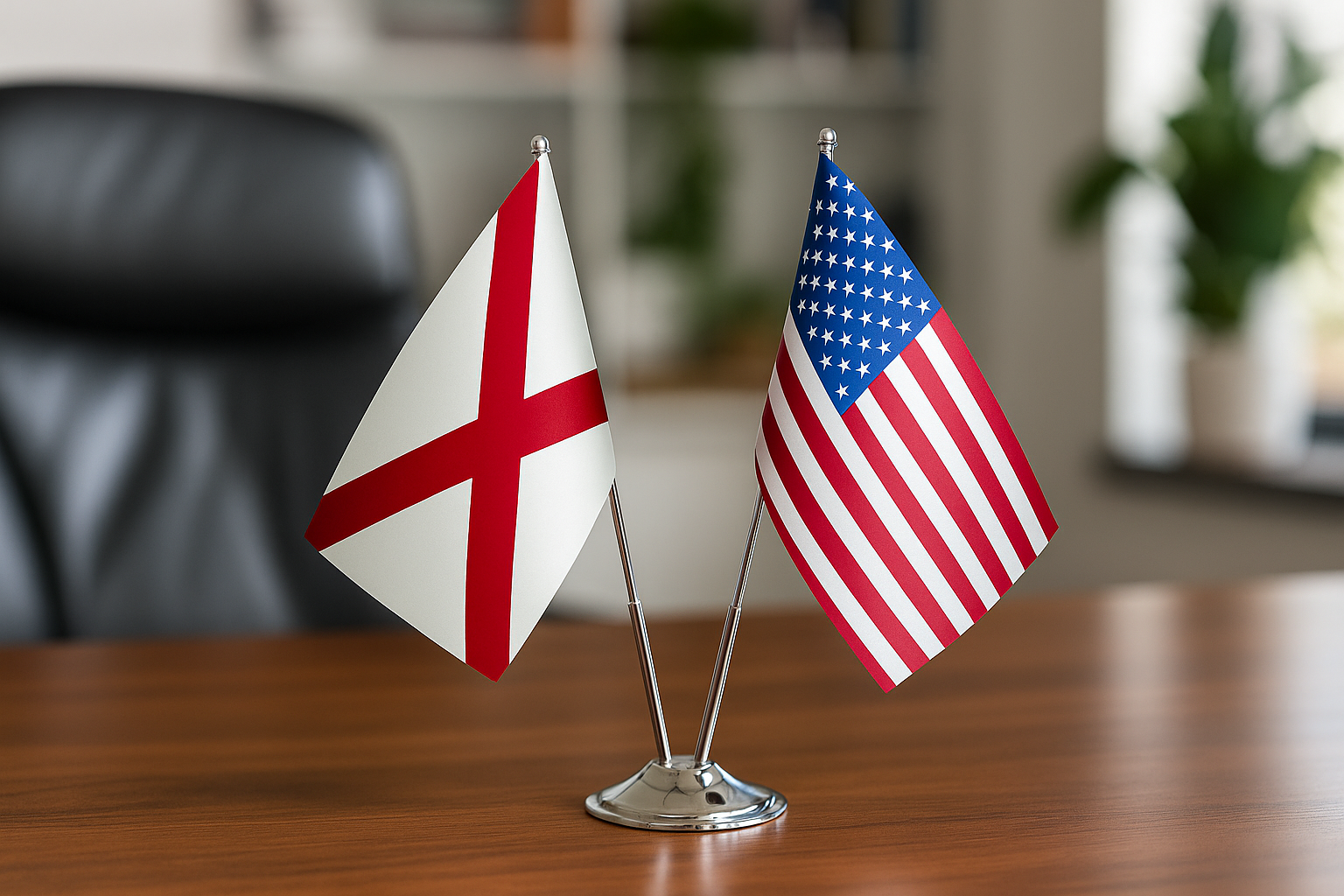
 Beyond floor stands, municipal conference rooms and elected officials' offices often require desk flag sets — small flags mounted on weighted desktop stands that sit on council tables, mayoral desks, and reception counters. A premium weighted metal base provides the stability these settings demand, preventing flags from tipping during meetings and projecting the formal professionalism expected of a government workspace. For multi-department procurement, desk flag sets configured for dual or triple display are particularly cost-efficient, allowing a single stand to hold both the US and state flags side by side without requiring multiple individual bases. The Luxury Chrome Gold Desk Flag Stand is available in single through five-flag configurations, making it a flexible choice for everything from a single mayor's office to an entire city council chamber. Pairing these stands with flags from the US State Dual Desk Flag Sets collection lets procurement officers order a complete, coordinated desk display solution in one transaction.
Fabric choice for indoor flags differs from outdoor requirements. Since indoor flags are not exposed to UV or wind stress, they can use lighter materials like 100% nylon or polyester blends that hold color vibrancy and drape elegantly. Gold fringe along three edges is the traditional treatment for formal indoor government flags and is standard in courtrooms, legislative chambers, and ceremonial spaces. When specifying indoor flag sets for a government building package, require matching pole finishes — typically polished brass or chrome — and matching eagle or spearhead ornaments across all three poles for a visually unified display. The Indoor Flags collection and the State and City Indoor Flags collection both offer the full range of state flags, US flags, and municipal flag options needed to equip government offices to code.
Custom Civic Flags and Branding for Municipal Campuses
Many municipalities maintain official city or county flags that are displayed alongside the US and state flags, and ordering these as civic flags bulk order quantities is often the most cost-effective route for a government purchasing department. Custom civic flags should conform to FIAV (Fédération Internationale des Associations Vexillologiques) good design standards — clear symbolism, limited colors (ideally two to three), no lettering if avoidable, and a design that reads legibly at a distance — but practical procurement concerns center on consistent color matching, durability, and lead times for custom production.
For outdoor custom civic flags, dye-sublimation printing on 200-denier nylon or heat-transfer printing on 600-denier polyester both produce excellent color fidelity when Pantone-matched colors are specified in the purchase order. Minimum order quantities for custom outdoor civic flags typically start at 10–25 units, making them entirely feasible for even smaller municipalities that need to outfit a handful of sites. Municipal procurement officers should request a physical pre-production sample — not just a digital proof — before approving a full civic flags bulk order, since color rendering can vary between monitor display and physical fabric. Lead times for custom civic flags generally run 10–21 business days from artwork approval, so government purchasing teams should plan procurement well ahead of installation deadlines, especially for new building openings, civic anniversary events, or legislative calendar requirements. The Logo Printed Outdoor Pole Flags collection provides a practical starting point for municipalities exploring custom branded flag options at scale.
State and City Indoor Flags
Complete indoor flag sets for government offices, council chambers, and civic spaces — available in all 50 state flags, US flags, and municipal options with matching hardware.
Browse Collection →Government Building Flag Procurement: Writing Specifications and RFP Language
Effective government building flag procurement begins with precise technical specifications that allow multiple suppliers to bid on an equal footing and protect the municipality from receiving substandard materials. Procurement specs should include fabric type and denier, construction method (sewn vs. printed), finished size with a stated tolerance of ±0.5 in (±1.3 cm), header material and thickness, number and type of grommets, colorfastness rating (minimum 4 on the ISO 105-B02 blue wool scale for outdoor flags), and expected minimum service life under defined conditions.
For municipalities subject to public procurement law — which covers virtually all city halls and county governments in the United States — the procurement process typically requires either a formal Request for Proposal (RFP) for larger orders or a simplified quote process for smaller purchases below the applicable threshold (commonly $10,000–$25,000 depending on state law). Including a "best value" evaluation criterion rather than a strictly lowest-cost award allows government buyers to weight quality, lead time, and supplier reliability alongside price. Municipal buyers should also specify delivery terms clearly — FOB destination, inside delivery, and palletized packaging for large multi-site orders prevents damage claims and simplifies distribution to individual building sites across a county. For municipal building flags wholesale purchases, negotiating a blanket purchase order or cooperative contract that covers 12–24 months of replacements at a fixed unit price is a best practice that reduces administrative overhead and locks in favorable pricing.
Replacement Cycles, Inventory Management, and Bulk Pricing Strategy
Most government buildings underestimate how frequently outdoor flags need to be replaced, which leads to the embarrassing sight of frayed, faded, or torn flags flying over public buildings. A structured replacement cycle built into the procurement plan prevents this: outdoor flags in high-exposure locations should be replaced every 90–120 days, while moderate-exposure sites can typically extend to 6–12 months before visible wear becomes unacceptable.
For a county government managing 10–20 properties, a practical inventory strategy involves maintaining a central flag stockroom with at minimum one full replacement set per active flagpole, plus a 20% buffer. This means a county with 30 outdoor flagpoles (US and state flags on each) should stock at least 72 replacement flags at any given time — enough to replace every flag once plus the buffer stock. Centralized storage reduces per-unit costs since wholesale outdoor flags for public buildings ordered in quantities of 50 or more typically price 25–40% lower than single-unit retail. Government purchasing officers should also track flag retirement properly: 4 USC § 8(k) specifies that worn US flags should be destroyed in a dignified manner, customarily by burning in a private ceremony, and many American Legion posts conduct flag retirement events that municipalities can partner with for proper disposal. Building a replacement schedule, a central inventory log, and a compliant retirement procedure into the procurement plan from the start transforms flag management from an ad hoc task into a professional, budget-predictable operation.
Frequently Asked Questions
What is the correct order of flags when displaying the US flag, state flag, and city flag together on an outdoor flagpole grouping at a city hall? +
What flag size should a 40 ft flagpole at a county courthouse use? +
Are there minimum order quantities for bulk municipal flag orders? +
What fabric is best for outdoor government building flags in high-wind environments? +
How should a municipality properly retire a worn US flag? +
What should be included in an RFP for government building flag procurement? +
Can we order matching indoor and outdoor flag sets for a government campus in a single purchase? +
Government purchasing teams ready to streamline their next flag procurement cycle can explore the full range of options through the Indoor Flags collection for office and ceremonial display needs, the State and City Indoor Flags collection for complete matched sets, and the USA Outdoor Flag product page for heavy-duty outdoor flags sized and built to government-grade standards. From a single county courthouse replacement to a multi-site municipal campus outfitting project, every order benefits from working with a supplier that understands US Flag Code compliance, protocol-correct display configurations, and the durability standards that public buildings require. Bulk pricing is available for corporate and government orders — contact the Asya Bayrak procurement team directly to discuss volume pricing, blanket purchase agreements, and custom civic flag production timelines tailored to your municipality's schedule and budget.


