
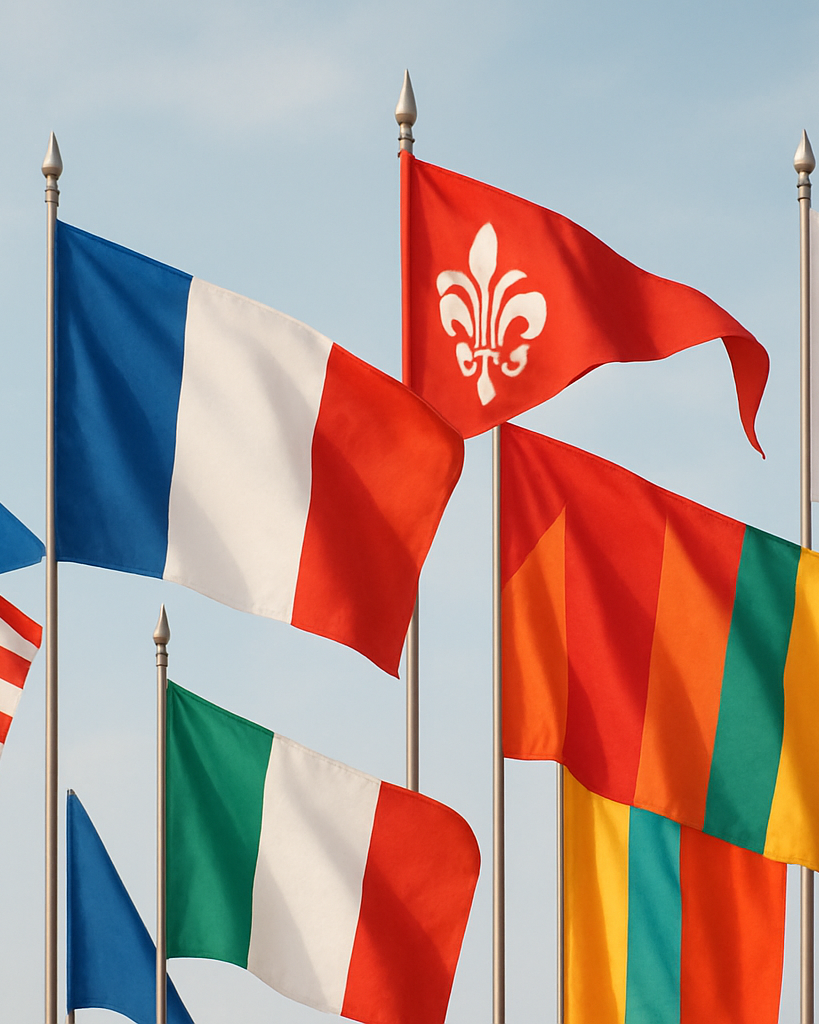


Feather flags are tall, curved advertising banners mounted on flexible fiberglass or aluminum poles that create constant motion to attract attention — making them one of the most cost-effective outdoor advertising tools available for businesses of any size. Whether you're promoting a grand opening, driving foot traffic to a retail location, or marking a real estate event, an advertising feather flag can increase visibility from distances of up to 100 ft (30 m) at a fraction of the cost of traditional signage. For a wide range of business-ready options, the Sail & Feather Flags collection at Asya Bayrak offers professionally manufactured flags built for real outdoor conditions.
What Makes Feather Flags So Effective for Business Advertising?
Feather flags outperform static signage in high-traffic environments because their natural movement triggers the human eye's peripheral motion detection, drawing attention even when passersby aren't actively looking. Studies in outdoor advertising have consistently shown that animated or moving displays generate up to 400% more views than static equivalents of the same size.
The aerodynamic teardrop or feather profile is engineered so the flag wraps naturally around the pole in wind and snaps back into full display as the wind drops, keeping your graphics continuously visible rather than rolling up like a banner. This self-correcting behavior is critical in parking lots, along roadways, or at storefront entrances where wind direction changes constantly. The tall, narrow footprint — typically ranging from 8 ft to 16 ft (2.4 m to 4.9 m) in height — also allows businesses to create a strong vertical presence in locations where horizontal real estate is limited. When several feather flags are lined up along a curb or entryway, they create a corridor effect that naturally guides customers toward your door. No other portable signage format achieves that combination of height, movement, and footprint efficiency at this price point.
Feather Flag Shapes and Sizes: Choosing the Right Format
The most common advertising feather flag shapes are the classic feather/teardrop, the straight rectangular "blade" style, and the drop or teardrop variant — each offering different graphic display characteristics and wind behavior. Selecting the right shape depends on your graphic content, wind exposure, and viewing distance.
 The classic feather shape features a curved leading edge that gives the flag its name, providing a large printable face area that's wider at the top and tapers toward the base — ideal for logos, short brand names, or high-contrast graphics. The drop or teardrop variant offers a more symmetrical profile with a rounded top and bottom taper, which tends to behave more predictably in variable wind conditions. Blade-style flags present a rectangular face with minimal curve, maximizing the usable print area for detailed messaging or imagery. For most retail and event advertising scenarios, teardrop and feather shapes in the medium range — 11 ft to 13 ft (3.4 m to 4 m) — offer the best balance of visibility and manageability. If you need a versatile pole system to support different flag shapes, the beach flag pole at Asya Bayrak is compatible with multiple flag formats and ground mount options.
Size selection should be tied to your viewing distance and location type. For curbside roadway placement where drivers are the primary audience, taller flags in the 15 ft to 17 ft (4.6 m to 5.2 m) range are appropriate. For pedestrian zones, trade show floors, or indoor lobbies, a compact 8 ft to 10 ft (2.4 m to 3 m) flag avoids overwhelming the space while still commanding attention. Always confirm local zoning or property regulations before installation — some municipalities classify flags above a certain height as temporary signage requiring a permit.
Material and Print Quality: What to Look for in an Advertising Feather Flag
The best advertising feather flags are made from 110–115 gsm knitted polyester with dye-sublimation printing — a process that bonds ink directly into the fabric fibers rather than sitting on top, resulting in colors that are 80% UV resistant and a lifespan of 6 months to 2 years under typical outdoor conditions. Cheaper flags use coated fabrics with screen or inkjet printing that can fade, crack, or peel within weeks of outdoor exposure.
 Dye-sublimation on knitted polyester also allows the ink to pass partially through the fabric, which means the graphic is often readable from both sides — a significant advantage for flags placed at intersections or entrances where customers approach from multiple directions. Look for double-stitched hems and reinforced sleeve channels, as these are the points of highest mechanical stress on any flag in outdoor wind conditions. The sleeve — the fabric tube that threads onto the pole — should be made from a heavier webbing material than the flag face itself, rated for at least 10,000 flex cycles before showing wear. The drop-shaped flag from Asya Bayrak uses precisely this construction approach, combining a durable sleeve with a vibrant dye-sublimated print face suitable for full-color brand graphics. When evaluating suppliers, always ask for GSM weight, ink type, and stitch count per inch on the hem — these three numbers tell you almost everything you need to know about outdoor durability before purchasing.
Pole Systems, Bases, and Hardware: The Foundation of Reliable Display
A feather flag is only as reliable as its pole and base system — a high-quality flag attached to an undersized or poorly engineered pole will fail in moderate wind, which is both a safety hazard and a waste of your printing investment. For most business advertising applications, a sectional fiberglass or anodized aluminum pole rated for winds of 25–35 mph (40–56 km/h) is the appropriate specification.
Pole systems for advertising feather flags typically come in three to five sectional pieces for easy transport and storage, with a flexible top section — usually fiberglass — that absorbs wind load through flexion rather than rigidity. This design prevents the mechanical fatigue that would snap a rigid pole in gusty conditions. The base hardware options include ground spikes for grass or soft earth, water-filled bases for hard surfaces like concrete or asphalt, and cross bases for temporary indoor or outdoor flat-surface use. Water-filled bases typically hold 8–12 gallons (30–45 liters) when full, providing sufficient ballast for flags up to 14 ft (4.3 m) in moderate wind. For businesses that move their flags frequently between locations — a common pattern for real estate agents, food trucks, and pop-up retailers — the entire kit should pack into a carrying bag no larger than 60 in (152 cm) long. Before investing in any system, read our detailed breakdown of what's actually included in feather flag pole kits to avoid unexpected add-on costs.
Best Business Applications for Feather Flags
Feather flags deliver the highest ROI in high-traffic, time-sensitive advertising scenarios where visibility must be established quickly and moved easily — retail grand openings, seasonal sales events, food and beverage promotions, auto dealerships, and real estate open houses are the core use cases. Any business that needs to announce "we are here" to moving traffic within a tight budget should consider feather flags as a primary outdoor advertising tool.
Auto dealerships often line their lots with 10–20 matching feather flags in brand colors to create a cohesive visual identity visible from the road. Real estate professionals use them at open house locations to guide buyers from the nearest arterial road directly to the property — a practical application that requires fast setup and takedown, which the ground spike base handles in under two minutes. Restaurants and food businesses use feather flags to announce daily specials or seasonal menus with interchangeable flag faces on permanent pole systems. For businesses involved in property development and site marketing, our guide on branded outdoor flags for real estate offices and model homes provides specific strategies for deploying feather flags at scale across multiple sites. Trade shows represent another high-value scenario — feather flags placed at the entrance to a 10 ft × 10 ft (3 m × 3 m) booth can increase visitor engagement by creating a sense of presence that a table banner alone cannot achieve.
Sail & Feather Flags Collection
Complete range of professionally manufactured feather and sail flags in multiple shapes and sizes, ready for full-color custom printing and real outdoor advertising conditions.
Browse Collection →Customization: Getting Your Brand Onto a Feather Flag Correctly
Effective custom advertising feather flags require artwork prepared specifically for the flag's curved, tall format — standard rectangular logo layouts rarely translate well without redesign. The single most common mistake businesses make is submitting a horizontal banner design to a flag printer without adjusting for the vertical 3:1 to 4:1 aspect ratio of a feather flag face.
For best results, your design file should be vector-format (AI or EPS) or a high-resolution raster at 150 DPI at full print size, with a minimum 0.5 in (13 mm) bleed on all edges. Because the sleeve side of the flag (the left edge as viewed from the front) is occupied by the pole channel, your critical brand elements — logo, phone number, call to action — should be positioned toward the center and right-leading-edge of the design. Color profiles should be CMYK for print accuracy, and any spot colors should be matched using Pantone references to ensure brand consistency across multiple flags in a set. Text legibility is the biggest practical challenge: at highway speed, a viewer has approximately 3–5 seconds of exposure, meaning your flag should communicate one idea in lettering no smaller than 8 in (20 cm) tall for roadside viewing. Keep copy to five words or fewer when targeting vehicle traffic. For businesses ordering flags at scale — franchises, event companies, or property developers — working from a master template that all sites can customize within brand guidelines ensures visual consistency without requiring individual design reviews for every order.
Maintenance, Storage, and Longevity
With proper care, a quality advertising feather flag printed on 110 gsm dye-sublimated polyester will last 12–18 months of continuous outdoor use, or 2–3 years if rotated or stored indoors when not in active use. The primary enemies of flag longevity are UV degradation, abrasion at the sleeve, and mechanical fatigue at the top cap where the pole meets the flag.
To maximize lifespan, bring flags indoors during extended periods of high wind (sustained winds above 35 mph / 56 km/h), heavy rain, or when the business is closed for several days. Washing should be done by hand or on a gentle machine cycle in cold water with no bleach, and flags should be air-dried completely before storage to prevent mildew in the sleeve channel. Inspect the pole sleeve stitching monthly — catching a fraying seam early with a simple whipstitch repair can extend flag life by several months. Store flags loosely rolled or folded around an acid-free tube rather than tightly folded along the same crease lines, which causes permanent fabric weakening at fold points. Pole sections should be wiped down with a dry cloth and stored in their carrying bag; aluminum sections are particularly susceptible to pitting if left damp. A business that maintains this basic rotation and care schedule will find that their per-impression cost for feather flag advertising drops to fractions of a cent — making them genuinely one of the most economical outdoor advertising formats available.
Frequently Asked Questions About Feather Flags for Business Advertising
How long do advertising feather flags last outdoors? +
What is the difference between a feather flag and a teardrop flag? +
Do I need a permit to display a feather flag at my business? +
What base type is best for a feather flag on concrete or pavement? +
Can feather flags be used indoors at trade shows? +
What file format should I submit for custom feather flag printing? +
How many feather flags do I need for effective roadside advertising? +
Feather flags remain one of the most versatile and cost-efficient advertising tools a business can deploy — combining portability, custom branding, and eye-catching movement in a format that sets up in minutes and stores in a bag. For complete hardware systems, explore the beach flag pole options that pair with every flag style, or browse the full range of shapes and sizes in the Sail & Feather Flags collection. If you're working on a property marketing campaign or multi-site deployment, the outdoor feather flags guide for real estate open houses and property sales events covers quantity planning and placement strategy in detail. Bulk pricing is available for corporate orders — contact Asya Bayrak directly for volume quotes on sets of 10 or more flags with matching pole kits.


