




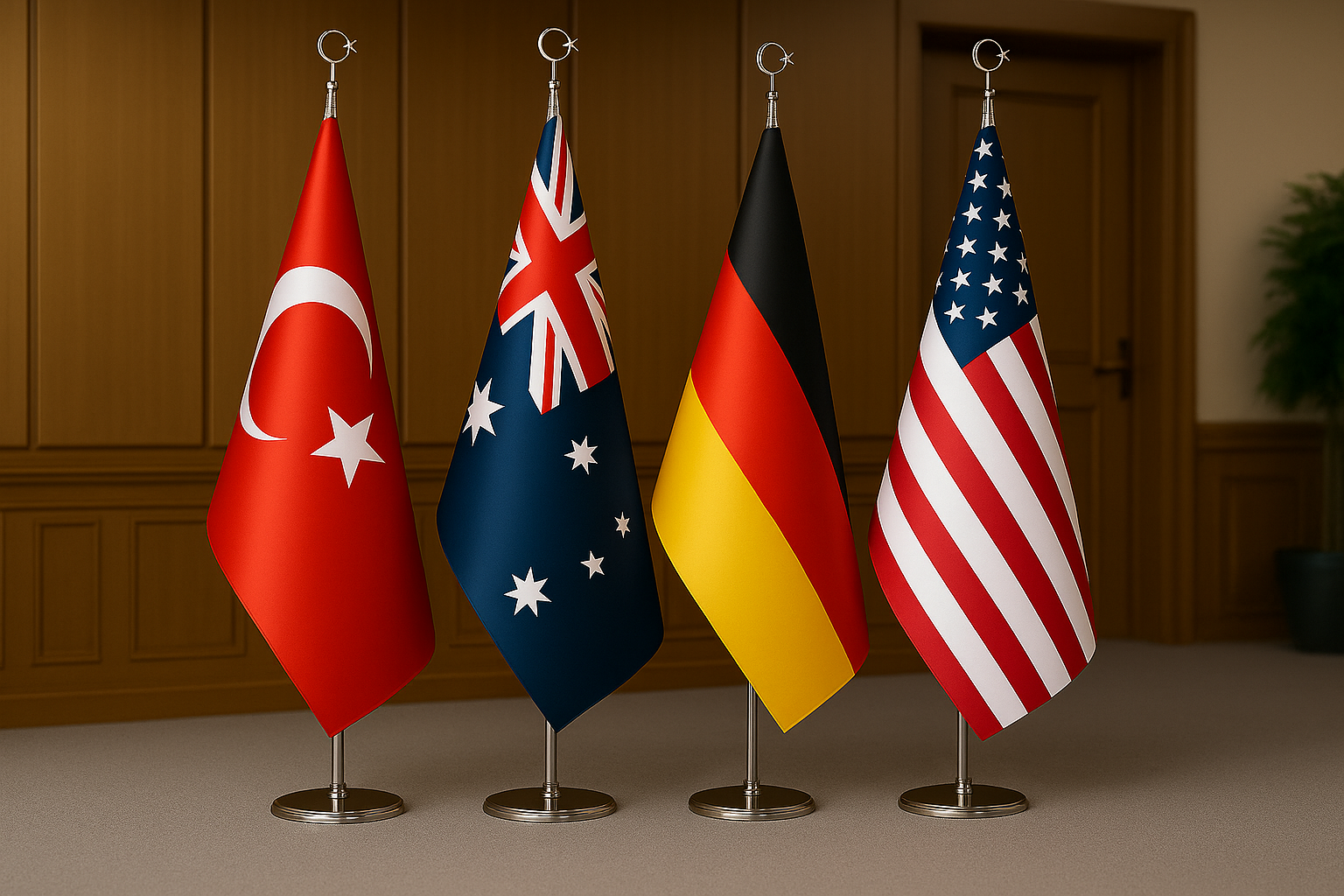




The Ohio flag must be displayed with its fly end — the swallowtail point — facing away from the flagpole or staff, with the blue triangle toward the hoist, following both Ohio Revised Code § 5.01 and general US Flag Code (4 USC §§ 1–10) principles that govern state flag display alongside the national colors. Whether you're setting up a courthouse lobby, a classroom, or a government office, flying Ohio's unique burgee correctly is both a legal matter and a mark of institutional respect. Browse the full State and City Indoor Flags collection to find Ohio flags built to official display standards.
What the US Flag Code and Ohio Law Say About Flying the Ohio Flag
The US Flag Code (4 USC §§ 1–10) establishes national display principles, and Ohio Revised Code § 5.01 codifies the design and official use of the state burgee — together, these two legal sources govern how the Ohio flag must be treated in any public or ceremonial setting. The Ohio flag is the only non-rectangular state flag in the United States: it is a swallowtail burgee, officially adopted in 1902, with precise proportions defined by law — the width is three-fifths of the fly length. This unique shape creates display obligations that rectangular flags do not share. Unlike a standard flag, the swallowtail's two pointed notches at the fly end must always remain visible and unobstructed; folding or rolling the flag in a way that conceals the distinctive shape violates the spirit of the code. Ohio Revised Code also specifies the exact arrangement of the red and white stripes, the blue triangular field, the white circle with the red disc (the "O" and buckeye motif), and the 17 stars — 13 for the original colonies plus 4 representing Ohio as the 17th state admitted to the Union. Familiarity with both federal and state law is the first responsibility of any institution that displays this flag.
How the Ohio Flag Ranks in Order of Precedence on a Flagpole or in a Room
When displayed with the US flag, the Ohio state flag always yields precedence: the US flag occupies the position of honor — the peak of the pole, the right side of a platform, or the far right of a row of flags when viewed by the audience. On a single outdoor flagpole, the US flag flies at the top with the Ohio flag immediately below. In an indoor ceremonial setting with staffs arranged in a row, the US flag stands to the speaker's right (the audience's left), and the Ohio flag stands immediately to its left. If additional flags are present — other state flags, municipal flags, or organizational banners — Ohio takes precedence over them all within the state, but always defers to the national colors. When flags of multiple states are displayed together, protocol requires they be flown at equal height and in alphabetical order unless a specific state is being honored. Never place the Ohio flag to the right of the US flag or higher on the same pole; doing so inverts the established order of precedence under 4 USC § 7.
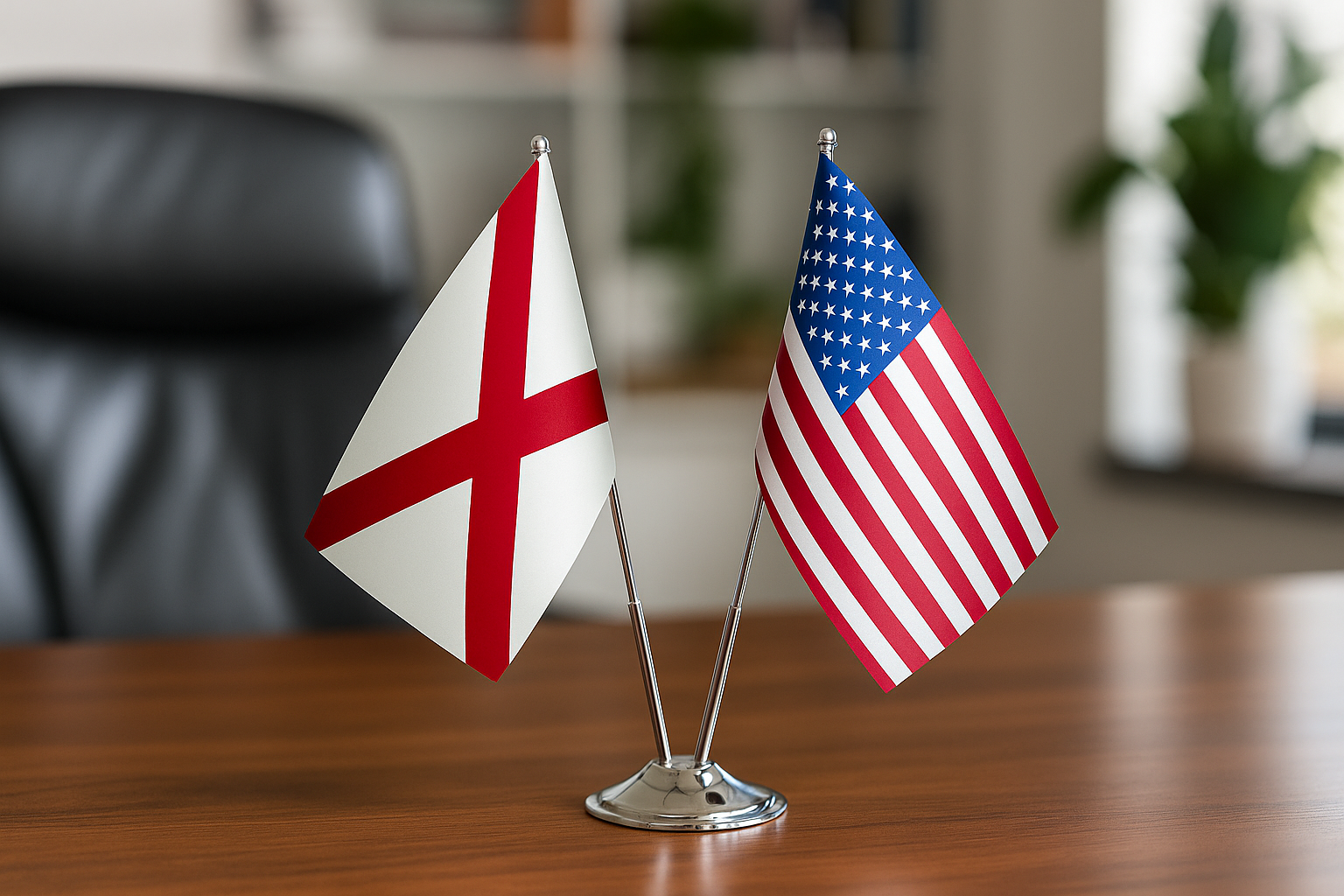
 For desk and tabletop display, precedence rules translate directly to placement: the US flag goes to the right of the Ohio flag when both are displayed on a desk, meaning if you are seated behind the desk, the US flag is at your left and the Ohio flag at your right — because the position of honor is always from the viewer's perspective, not the displayer's. The Ohio State Desk Flag reproduces the burgee's red, white, and blue with the official buckeye leaves design in accurate detail, making it appropriate for office desks, classroom lecterns, courtroom benches, and reception counters. A compact desk flag does not diminish protocol obligations — the same order-of-precedence rules apply regardless of flag size. Pairing it correctly with a US desk flag ensures your display is compliant and visually authoritative from the moment a visitor enters the room. For sizing guidance on other state flags used in similar settings, the article on California flag sizes for offices and classrooms offers useful parallel guidance on indoor institutional display.
What You Are Prohibited from Doing with the Ohio Flag
The Ohio flag may not be used as wearing apparel, bedding, drapery, or as a receptacle for carrying or delivering anything — these prohibitions mirror 4 USC § 8, which applies to all US flags and, by the same standard of respect, to state flags displayed in a public context. The swallowtail shape makes an additional set of prohibitions especially relevant: the flag must never be displayed flat against a wall in a way that distorts or folds the tail, because misrepresenting the unique silhouette misrepresents the flag's legal identity. Printing the Ohio flag design on disposable items — paper plates, napkins, plastic cups — is contrary to the standard of respect established by Ohio Revised Code § 5.01, even if no criminal penalty attaches to purely private use. The flag must not be flown when it is torn, faded beyond recognition, or missing any of its design elements; a flag in this condition should be retired through a dignified ceremony, traditionally by burning. Attaching anything to the staff above the Ohio flag (other than the US flag) is prohibited in an official context. Finally, the flag may not be used as an advertising device or printed on merchandise in a commercial context that implies official state endorsement — a distinction that matters for businesses that display the flag in their branding.
Half-Staff Orders and Ceremonial Occasions for the Ohio Flag
The Ohio flag flies at half-staff only when the US flag is also ordered to half-staff, unless the Governor of Ohio issues a separate executive proclamation specifically covering the state flag — a power explicitly recognized in Ohio Revised Code. When a half-staff order is in effect, both the US and Ohio flags are first raised to full-staff, then lowered to half-staff; they are raised to full-staff again before being retired at the end of the day. This raise-then-lower sequence is not optional — it is required by 4 USC § 7(m) and applies equally to the state flag displayed alongside the national colors. For ceremonial occasions such as Ohio statehood anniversaries, the governor's inaugural, or specific state memorial days, the Ohio flag may be given a place of special prominence in the ceremony, but it still yields to the US flag in physical positioning. In funeral ceremonies or memorial processions within Ohio, it is appropriate to display the state flag draped (not the US flag) over a state official's casket, provided the flag is properly oriented with the blue triangle toward the head of the casket. Military funerals use the US flag for casket draping under a separate federal protocol — the Ohio flag in that context is displayed on a separate staff nearby.
 A paired desk display is one of the most common ceremonial arrangements in Ohio government offices, and doing it correctly requires both flags to match in quality and proportion. The Ohio & U.S. Desk Flag Set provides both flags as a coordinated unit, with the Ohio state burgee and the Stars and Stripes available on Silver Chrome or Gold pole finishes, so the pairing looks intentional and professionally matched rather than improvised. This set is well-suited for governor's offices, state agency reception desks, and public ceremonial tables where dual-flag display is the expected standard. Having both flags from the same source also ensures consistent flag height and proportional balance — important when a display is photographed for official communications or public records. The question of whether a state flag can fly at the same height as the US flag is addressed in more detail in the article Can the Texas Flag Fly as High as the US Flag?, which covers the general federal-state precedence rule that applies equally to Ohio.
A Practical Display Checklist for Ohio Government Offices and Schools
Institutions that display the Ohio flag regularly benefit from a written protocol checklist that covers orientation, condition, lighting, and storage — because errors in flag display are often the result of institutional habit rather than deliberate disrespect. Use the following checklist to audit your display before any public event or official proceeding.
- Orientation: Confirm the blue triangular field is at the hoist (staff side) and the swallowtail points face outward, away from the pole.
- Order of precedence: US flag is to the right of the Ohio flag when viewed from the audience. On a pole, US flag is at the top.
- Flag condition: Inspect for fading, fraying, tears, or missing design elements. Replace any flag that can no longer be clearly identified as Ohio's burgee.
- Lighting: If displayed outdoors overnight, a dedicated light source must illuminate the flag per 4 USC § 6(a). For guidance on overnight display rules, see Do You Need a Light to Fly a Flag at Night?
- Half-staff protocol: Monitor the Governor's office and White House proclamations. Maintain a written log of half-staff periods for institutional records.
- Storage: Store the flag rolled (not folded into the traditional triangle — that method applies to the US flag only) to preserve the swallowtail shape without creasing the pointed ends.
- Retirement: Establish a flag retirement schedule. A flag that has served its useful life should be retired respectfully, typically through a ceremonial burning coordinated with a local veterans' organization or civic group.
- Replacement stock: Keep at least one backup flag on hand so a worn flag can be replaced immediately without leaving the display position empty.

State and City Indoor Flags
Official-grade indoor flags for all 50 states and major cities, built for the display standards required by government offices, schools, and public institutions.
Browse Collection →How to Choose an Ohio Flag That Meets Official Display Standards
An Ohio flag used in any official or institutional context should accurately reproduce all legally defined design elements: the five red and white horizontal stripes, the triangular blue field, the 17 stars arranged correctly, and the white circle with the red disc and buckeye leaf design. Display-grade flags for indoor settings benefit from high-definition sublimation printing, which renders the fine detail of the buckeye motif and the precise color values of the official red, white, and blue without fading under interior lighting over time. The Ohio Official Indoor Flag is produced from double-layer satin fabric on a durable chrome metal pole, with the burgee faithfully reproduced via high-definition sublimation printing — making it appropriate for state legislature halls, governor offices, courthouses, and public institutions where accuracy is non-negotiable. For smaller formats, the USA State Desk Flags collection offers compact, professionally finished options suitable for desks, podiums, and ceremonial table arrangements. When selecting a flag for recurring outdoor use, confirm that the fabric carries a UV-resistance rating — outdoor-grade flags should be rated at least 80% UV resistant for a useful service life of 6 months to 2 years depending on sun and wind exposure.
Why is the Ohio flag shaped like a swallowtail instead of a rectangle? +
Can the Ohio flag fly on the same pole as the US flag? +
What is the correct way to fold the Ohio swallowtail flag for storage? +
Does the US Flag Code legally apply to the Ohio state flag? +
When does the Ohio flag fly at half-staff? +
What do the symbols on the Ohio flag mean? +
Is it acceptable to display the Ohio flag outdoors at night without lighting? +
Flying Ohio's distinctive swallowtail burgee correctly is both a legal obligation and a statement of institutional integrity. Whether you are equipping a state legislature chamber, a school classroom, or a government reception desk, choosing a flag that accurately reproduces Ohio's legally defined design elements is the essential first step. Explore the State and City Indoor Flags collection for official-grade Ohio flags built for institutional display, or shop the USA State Desk Flags collection for compact formats suited to desks and lecterns. For a perfectly matched dual display, the Ohio & U.S. Desk Flag Set pairs both flags on coordinated poles in one order. Bulk pricing is available for corporate, government, and institutional orders — contact us directly to discuss volume requirements and custom specifications.


